Which termite you are looking at
Three groups account for almost every US infestation, and they are found in different places, produce different evidence and demand different treatments. Knowing which one you have changes what the signs below mean.
| Type | Where it lives | The evidence you find | Typical treatment |
|---|---|---|---|
| Native subterranean (Reticulitermes) | Soil colonies, usually within a few feet of the structure; the most common termite in most of the US | Mud tubes on foundation walls and piers, mud-packed galleries in wood, spring swarms | Liquid soil barrier or bait stations |
| Formosan subterranean | Also soil-based, but colonies are far larger and can nest above ground; invasive and spreading | The same mud tubes, plus heavier damage in a shorter time; swarmers about 1/2 inch and golden brown versus roughly 3/8 inch and black for native species | Professional bait plus barrier programs; often both |
| Drywood (Incisitermes and relatives) | Inside the wood itself with no soil contact — humid coastal states, attics, furniture, trim, floors | Kick-out holes with pellets below them, galleries that run across the grain and stay smooth and clean | Local removal or injection; fumigation for extensive infestations |
1. Mud tubes on foundations, piers, or walls
Pencil-width brown tubes climbing a concrete foundation are the signature of subterranean termites — the most destructive group in the US. They travel inside these tubes because their bodies dry out quickly in open air. Break a section open: live termites inside confirm an active colony; a dried-out empty tube only means termites passed through at some point. Either way, check again after a week — rebuilt tubes mean activity.
2. Swarmers or discarded wings
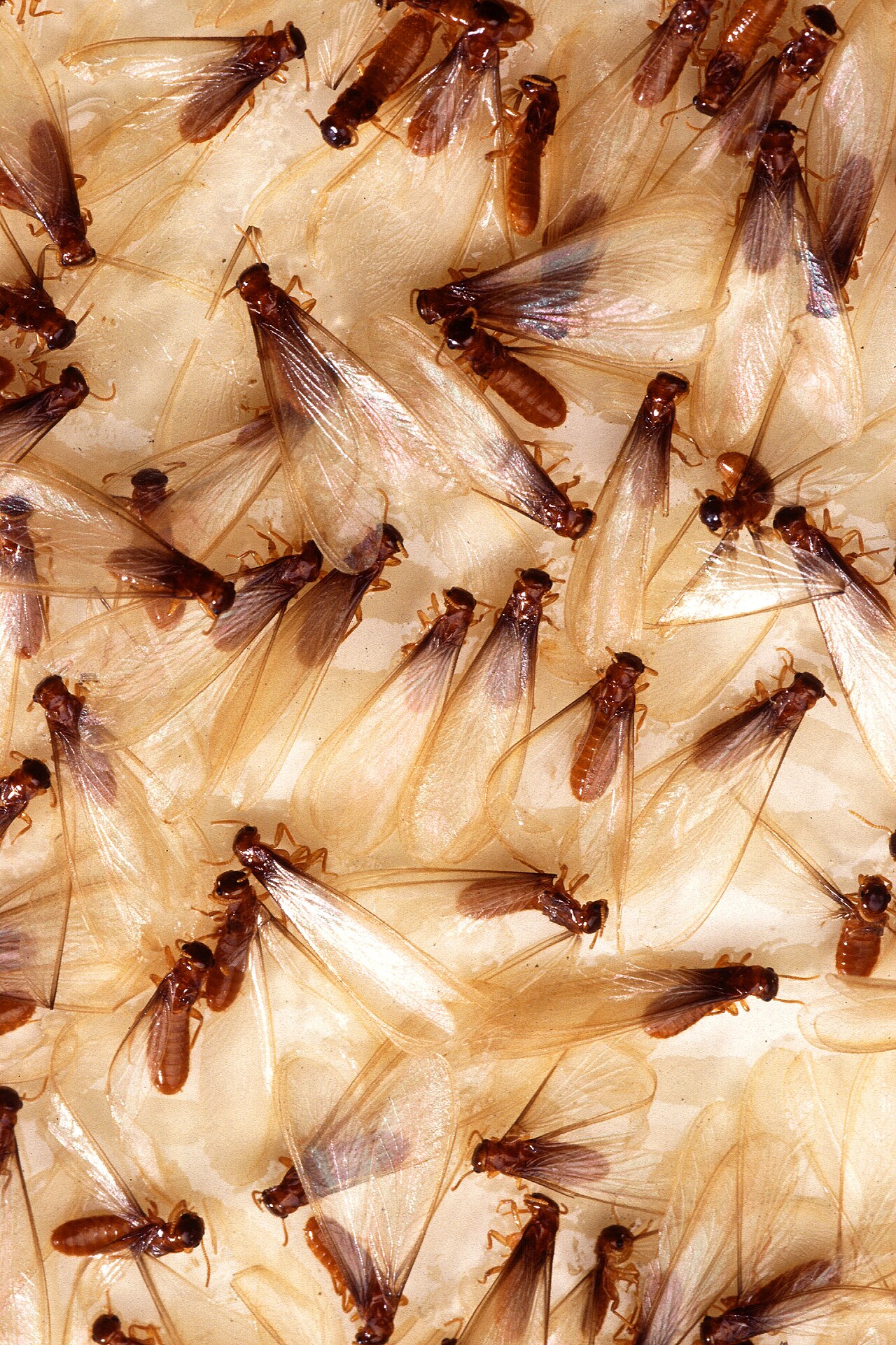
Winged reproductives emerge in spring (subterranean) or late summer and fall (drywood), usually after rain. Penn State describes the winged kings and queens as dark brown or black, about 3/8 to 1/2 inch long, with two pairs of translucent wings of equal length that break off shortly after swarming — and notes that very often the shed wings are the only evidence that termites are in a building. Piles of equal-length wings on windowsills are the classic indoor clue. Winged termites are attracted to light, which is why indoor swarms cluster at doors and windows.
One calming fact from the same source: the winged forms themselves do no damage. Their appearance is a location signal, not a verdict on structural harm.
3. Hollow-sounding wood
Tap baseboards, door frames, and window sills with a screwdriver handle. Termite-damaged wood sounds papery or hollow because workers eat the springwood between grain lines, leaving the darker summerwood as a thin shell.
4. Frass — drywood termite droppings
Drywood termites push their droppings out of small "kick-out" holes that they later reseal. Clemson's factsheet gives the detail that separates this from sawdust: the pellets are about 1/16 inch long, may be black, cream or a mix — a "salt and pepper" look — and each pellet has six dented sides, visible with a magnifying lens. They collect in small piles, like tiny stones, below the infested site: under window sills, on cobwebs in the garage, in attic corners. Unlike carpenter ants, termites do not leave sawdust.
5. Blistering or "water damaged" paint
Paint that bubbles or peels with no leak underneath can be termites working just beneath the surface. The catch: moisture damage looks similar. Probe it — termite galleries are packed with mud-like material, while water damage leaves stained, crumbly fibers.
6. Tight-fitting doors and windows
Termite moisture and tunneling warp frames. It is the most often-missed sign because everyone blames humidity. If one door sticks but its twin on the same wall opens fine, probe that frame.
7. Sagging floors or ceilings
Late-stage damage shows as floor boards that flex, tile that pops, or a ceiling with a new sag. Penn State's framing is worth keeping in mind at this stage: visible damage is usually the result of years of infestation, and termite problems generally show up a decade or more after construction. By this point the colony has been feeding for years — treat it as an emergency, not a DIY weekend.
8. Damaged wood with mud inside the tunnels
Any exposed damaged wood tells you who did it: termites pack galleries with soil and have a rough, muddy texture following the grain; carpenter ants excavate clean, smooth, sandpapered galleries and never eat the wood; wood-boring beetles leave round exit holes the size of a pinhead to a BB. Drywood termites sit between the two: they eat both across and with the grain, leaving clean, smooth galleries that run right up to the wood surface with only a thin layer intact. If you are unsure, compare photos in the wood decay vs termite checker.
9. Clicking sounds inside walls
Soldier termites bang their heads against wood to warn the colony — a faint clicking from inside a wall at night in a quiet room is a real, if less common, sign. Put your ear to the wall near suspected activity and turn everything off.
Termite swarm or flying ant? Four checks
This is the single most common misidentification in the whole list, and it takes ten seconds to settle. Winged ants swarm on the same warm spring days as termites, and both end up on a windowsill.
| Check | Termite | Flying ant |
|---|---|---|
| Waist | Broad — the body is roughly the same width from thorax to abdomen | Narrow and wasp-like, pinched between thorax and abdomen |
| Antennae | Straight, and they may droop | Elbowed — bent at roughly ninety degrees |
| Wings | Four wings of equal length, roughly twice the body length, that snap off easily | Front wings longer than the hind wings, about body length |
| What you find afterwards | Loose piles of identical detached wings | Usually no wing piles; ants keep or shed wings differently |
If the waist check is inconclusive because the insect is crushed or tiny, catch one in a jar and look at the antennae under a lamp — the elbow is unmistakable.
What each sign means for urgency
Not every sign carries the same weight. This is the honest ranking, from "watch it" to "call this week".
| What you found | What it tells you | When to act |
|---|---|---|
| A single dried-out mud tube | Termites used it at some point; may be old or abandoned | Re-check in a week; book an inspection if it is rebuilt |
| Shed wings indoors, no other sign | A swarm happened inside, which points at a colony in the structure | Inspection within days — the winged insects did no damage, but their presence did |
| Pellets below a kick-out hole | Active drywood infestation, often localized | Quote a localized treatment; remove infested wood where practical |
| Hollow wood or mud-packed galleries | Feeding damage already present | Treat now; do not wait for the next swarm season |
| Sagging floor, popping tile, sticking doors throughout | Long-running structural damage | Same week, and involve a structural contractor as well as pest control |
A 20-minute inspection route
You do not need tools beyond a flashlight, a screwdriver and a screwdriver handle to tap with. Work the building in this order, because it follows how subterranean termites arrive.
- Outside, at the foundation. Walk the perimeter and look for mud tubes on concrete, piers and sill plates, especially where the soil stays damp and where mulch touches siding.
- Every wood-to-ground contact. Deck posts, fence rails against the house, stair stringers, porch supports. Probe the base of each with the screwdriver — it should resist, not sink.
- Crawlspace or basement. Look up at the floor joists and sill plate for tubes, staining, or mud-packed seams. This is where the first evidence usually is.
- Interior, low and along walls. Tap baseboards, door frames and window sills. Listen for the papery note instead of a solid knock.
- Attic and upper floors. Drywood territory: check roof framing, trusses, and any furniture or trim for kick-out holes with pellets underneath.
- Record what you find. Date, location, and a photo with something for scale. A treatment quote goes faster with evidence, and a re-check in two weeks is how you tell active from historical.
What to do next
If any two of these signs are present, stop probing and price the fix. Treatment choice — liquid barrier, bait stations, localized injection, or fumigation for drywood — depends on the termite group, construction, and infestation spread. This is the one pest where professional treatment is usually worth it: the EPA describes soil-applied barrier termiticides as the most common treatment and notes that improper application can contaminate the home and nearby wells without protecting it.
Estimate your cost with the termite treatment cost estimator, see whether the damage might really be moisture with the wood decay vs termite checker, and read the fumigation process before you get a quote in the termite tenting cost guide. If you are not yet sure it is termites at all, the termite look-alikes guide covers the ants, beetles and borers that get mistaken for them.
Prevention that actually reduces risk
- Keep soil, mulch, and firewood at least 6 inches below any wood siding and 12+ inches from the structure.
- Fix downspouts and grading so water drains away from the foundation — subterranean termites follow moisture and the EPA lists keeping soil around the foundation dry as a core prevention step.
- Fill cracks in concrete foundations and around utility penetrations with cement, grout or caulk.
- Fix leaks immediately and keep foundation vents clear of plants and debris.
- Keep trees and shrubs from growing against exposed wood, and never store firewood or wood debris against the house.
- Replace exterior wood-to-ground contacts (fence posts, deck supports) with treated or non-wood materials.
- Get an inspection every 1–3 years in termite-prone states — most damage is found during routine inspections, not by homeowners.
Sealing entry points and managing moisture are the two highest-value moves. Termites do not march across open concrete by choice — they follow damp soil and wood-to-earth contact into your home.
Sources: US EPA, Termites: How to Identify and Control Them (billions in damage and over two billion dollars spent on treatment annually, the ant-versus-termite wing and antenna checks, the three common types, prevention list, and the professional-application warning); Penn State Extension, Eastern Subterranean Termites (swarmer size and colour, equal-length wings that break off, shed wings as the only evidence, the waist and antennae differences, swarming season, and the ten-years-plus timeline for visible damage); Clemson HGIC, Drywood Termites (1/16 inch six-sided pellets, kick-out holes, clean cross-grain galleries, colony size and treatment options); and Clemson HGIC, Termite bond and Formosan subterranean termites (Formosan swarmers about 1/2 inch and golden brown versus about 3/8 inch and black for native subterranean termites).