The short answer
If the "gnats" are hovering around your houseplants or circling the bathroom mirror, they cannot bite — fungus gnats and drain flies have no mouthparts for feeding on people. If you are getting bitten outdoors at dusk, especially anywhere humid, coastal, or near wet soil, you are almost certainly dealing with biting midges — the insects most people mean by "no-see-ums." Those absolutely bite, and badly.
Which "gnat" do you have?
| The "gnat" | Where you notice it | Does it bite? | The real problem |
|---|---|---|---|
| Fungus gnat (Sciaridae) | Houseplant pots, greenhouse trays, soggy soil — it runs or flies low over the dirt | No | Overwatered soil breeding larvae; a nuisance, not a health risk |
| Drain fly / moth fly (Psychodidae) | Bathroom and kitchen drains, sewer lines — fuzzy, moth-like, resting on walls near the sink | No | Organic slime inside drain pipes acting as a nursery |
| Biting midge (Ceratopogonidae) | Outdoors at dawn and dusk — humid yards, marshes, coastlines, lakeshores | Yes | Painful bite with a burning sensation; welts that itch for days |
Fungus gnats: no bite, but a loud message about your watering can
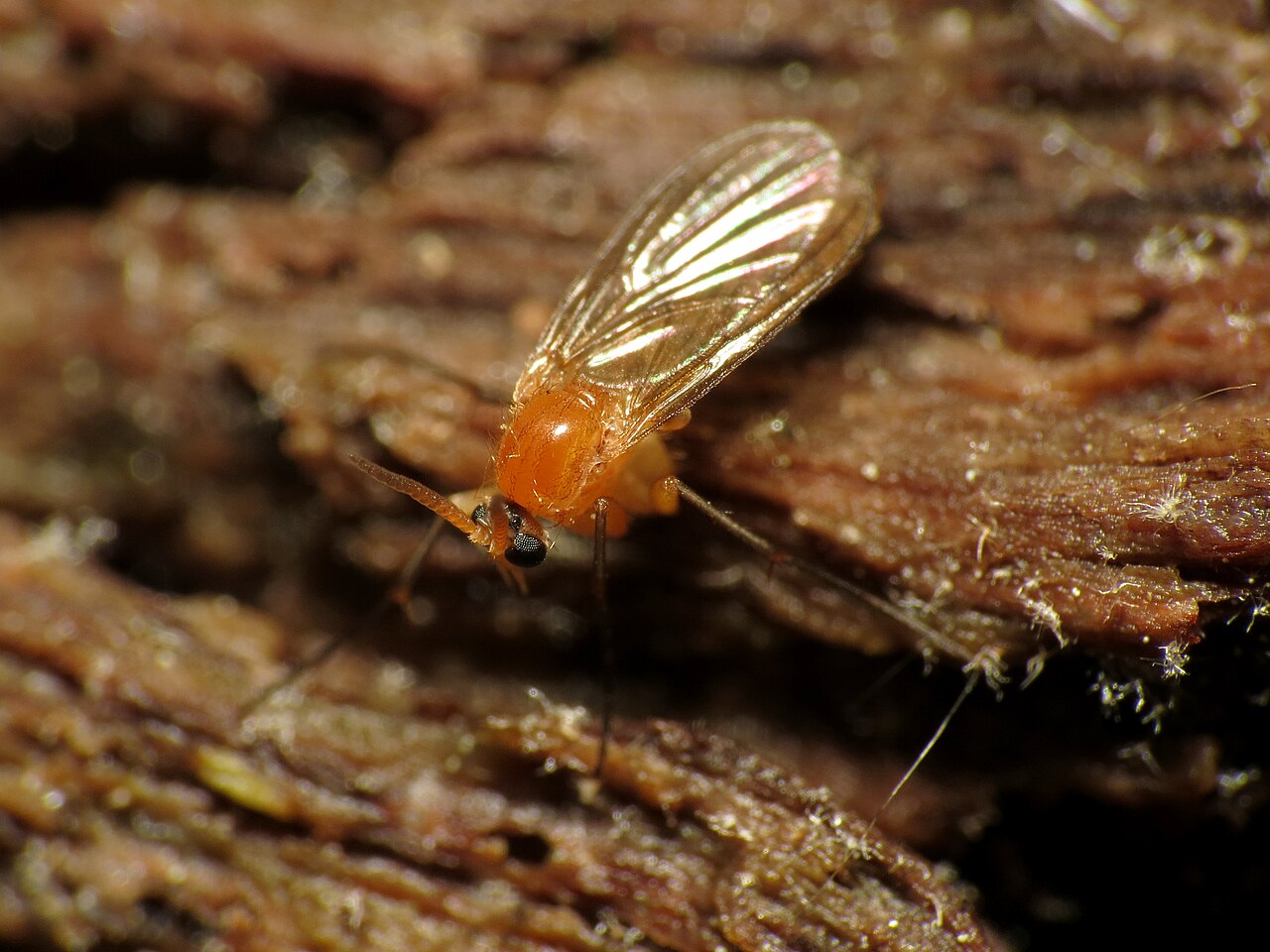
Fungus gnats are the little dark flies that lift off in a puff when you water your houseplants. Adults run just 1/16 to 1/8 inch long, with slender bodies, long legs, and wings usually folded flat over the back (University of Minnesota Extension). It is the larval stage that matters: the young live in the top inch of soil and feed on fungi and decaying organic matter — which is why they are "associated with over-watered soil or soil with high organic content."
The good news, straight from the extension services: fungus gnats do not harm people and typically do not harm plants either — they are a nuisance, not a biter and not a biter's stand-in. (In rare cases they can breed inside walls where moisture allows fungus to grow, which is a moisture problem wearing a gnat costume.) If they bother you, the fix is boring but effective: let the soil dry between waterings, use yellow sticky traps to catch adults, and repot with fresh soil if a pot stays wet.
Drain flies: the fuzzy ones that also never bite
Drain flies (also called moth flies, filter flies, or sewer flies) look like tiny furry moths resting on the bathroom wall. Clemson Extension's drain-fly fact sheet is blunt on the biting question — "Do they bite? No" — and describes them as harmless nuisance pests with wings held roof-like over the body (Clemson HGIC 2436). Their life cycle can complete in as little as two weeks, entirely inside the thin layer of organic sludge that builds up in drain pipes.
That last detail is the whole control strategy: you do not treat drain flies with sprays, you remove their nursery. Clean the drain with a brush or enzyme drain cleaner, clear standing slime from sink overflows and floor drains, and fix any slow drain that keeps the pipe permanently wet. The flies you see are the symptom; the slime film is the cause.
Biting midges: the gnats that absolutely do bite
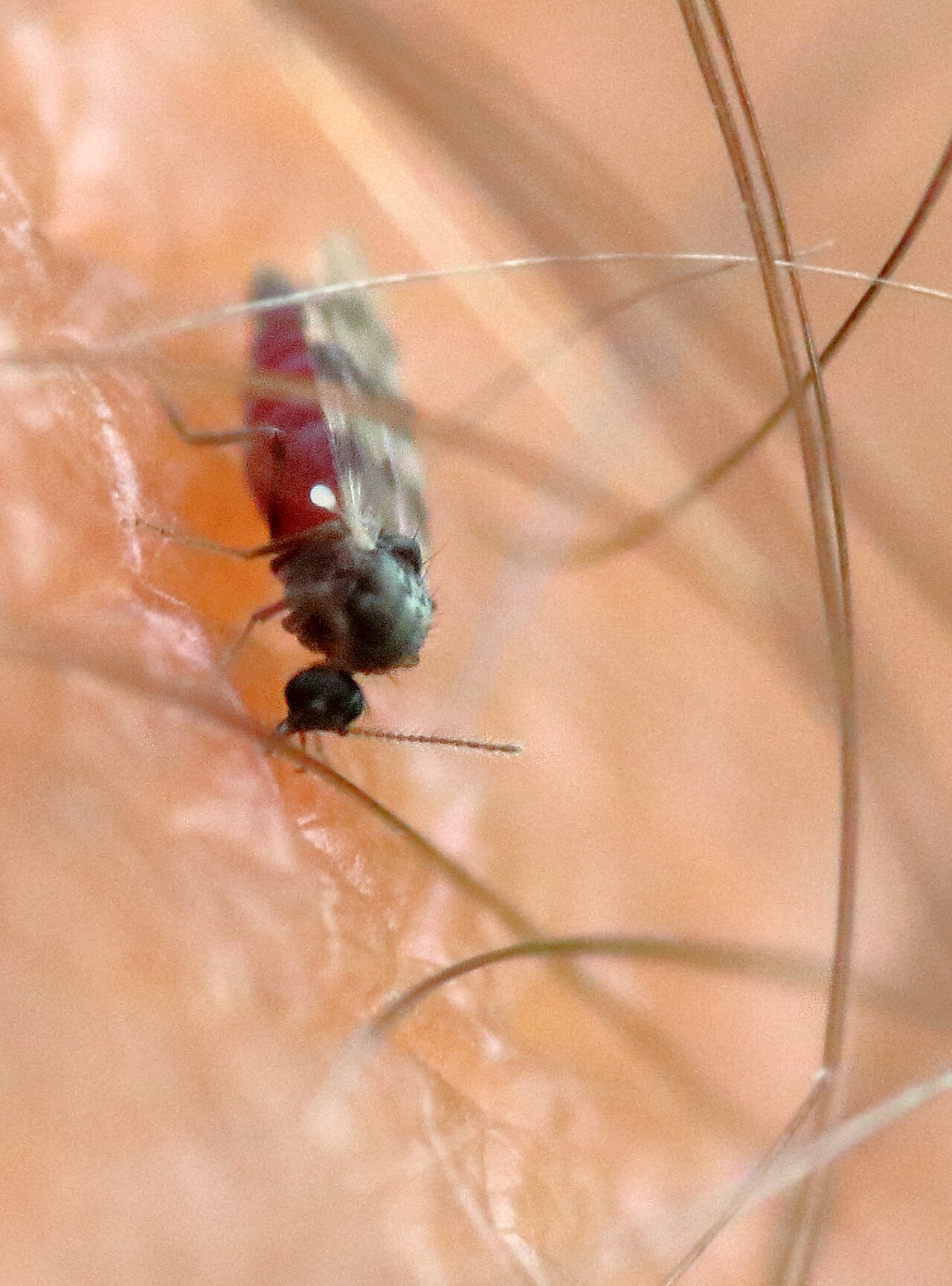
Biting midges are in a different weight class of problem entirely. They are the insects behind the names no-see-ums (North America), punkies (Northeast), five-O's (Florida and Alabama, for the 5 PM bites), and pinyon gnats (Southwest). At under a millimeter long — many species are smaller than 1/24 inch — they can slip straight through ordinary window screens, so "screened-in porch" is not the protection it sounds like (UF/IFAS EENY-349).
What the bite feels like is specific: Purdue's medical-entomology page describes a burning sensation at the moment of biting, followed by reactions that range from a small reddish welt to significant local allergic itching. The welts are the tell versus a mosquito — midge bites hurt instantly, then itch intensely for days. Biting midges are most active around dawn and dusk, and they are weak fliers that stay close to their breeding sites: damp soil, mud, marsh edges, and any wet organic debris.
One reassuring fact: in the United States, biting midges are not known to transmit disease to humans — their public-health impact here is the bites themselves (Purdue Extension). Elsewhere in the world the same family carries serious livestock diseases, which is why they are studied so heavily — but for a homeowner in the U.S., the problem is welts and ruined evenings outdoors.
How to tell which one is biting you — a 30-second check
- Where were you when the biting happened? Anywhere with wet soil, marsh edge, or coastline → biting midges. It is almost never a species that bites indoors — fungus gnats and drain flies simply do not.
- What time was it? Dawn or dusk bites that feel like burning are midge-typical. (The "five-O's" name comes from their 5 PM habit in the Southeast.)
- What do the bites look like? Small reddish welts, often clustered where clothing meets skin — ankles, wrists, waistline, hairline. If the bites are instead in lines of three or groups on exposed skin overnight, compare with the bed bug vs mosquito bite guide before blaming gnats.
- Can you catch one? If the insect you swat is fuzzy and moth-like near a drain → drain fly (harmless). If it lifts off plant soil → fungus gnat (harmless). If it is barely visible even when it bites you → midge.
If the insect is not on this list at all, the free pest ID wizard narrows it down by body shape, wings, and where you found it.
If midges are biting you: what actually helps
- Time your yard work around them. Midges peak at dawn and dusk; mowing, watering, or sitting out at those hours in a wet yard is volunteering.
- Use a repellent on exposed skin. The same EPA-registered repellent ingredients you use for mosquitoes (DEET, picaridin, IR3535) work on midges — apply before you go out, not after the bites start.
- Attack the breeding sites you control: standing water, soggy mulch beds, clogged gutters, and overwatered garden soil. The breeding-site inspection tool walks the same checklist — midges and mosquitoes share most of it.
- Add airflow where you sit. Midges are tiny and weak; a box fan on the patio keeps a surprising number off you.
- Dress for it at peak hours — long sleeves and pants give them far less skin to find.
If gnats are just buzzing around your plants
Then nothing is biting anyone, and you have a moisture problem in miniature. Let the top inch of soil dry out between waterings, move sticky traps near the soil surface, and check the garden version of the same problem in spring — fungus gnats thrive in damp seed-starting mixes, and the seasonal defense calendar covers when each soil pest pressure typically spikes. If the population does not drop after two weeks of drier soil, a soil-applied biological control (Bti or beneficial nematodes, sold for fungus gnat larvae) is the next step.
The bottom line
Two of the three "gnats" in your life are incapable of biting you — fungus gnats and drain flies are annoyances with a moisture-management fix. The one that bites, the biting midge, barely looks like an insect at all, fits through screens, and turns a summer evening outdoors into a welting session. Identify which one you actually have before you spend a dollar on treatment, because the fix for a plant-pot gnat is a dry watering can — and the fix for a midge is timing, repellent, and drying out the wet corners of the yard.
Sources for this guide: University of Minnesota Extension (fungus gnats), Clemson HGIC fact sheet 2436 (drain flies), Purdue Extension medical entomology (biting midges), and UF/IFAS Featured Creatures EENY-349 (biting midge biology).