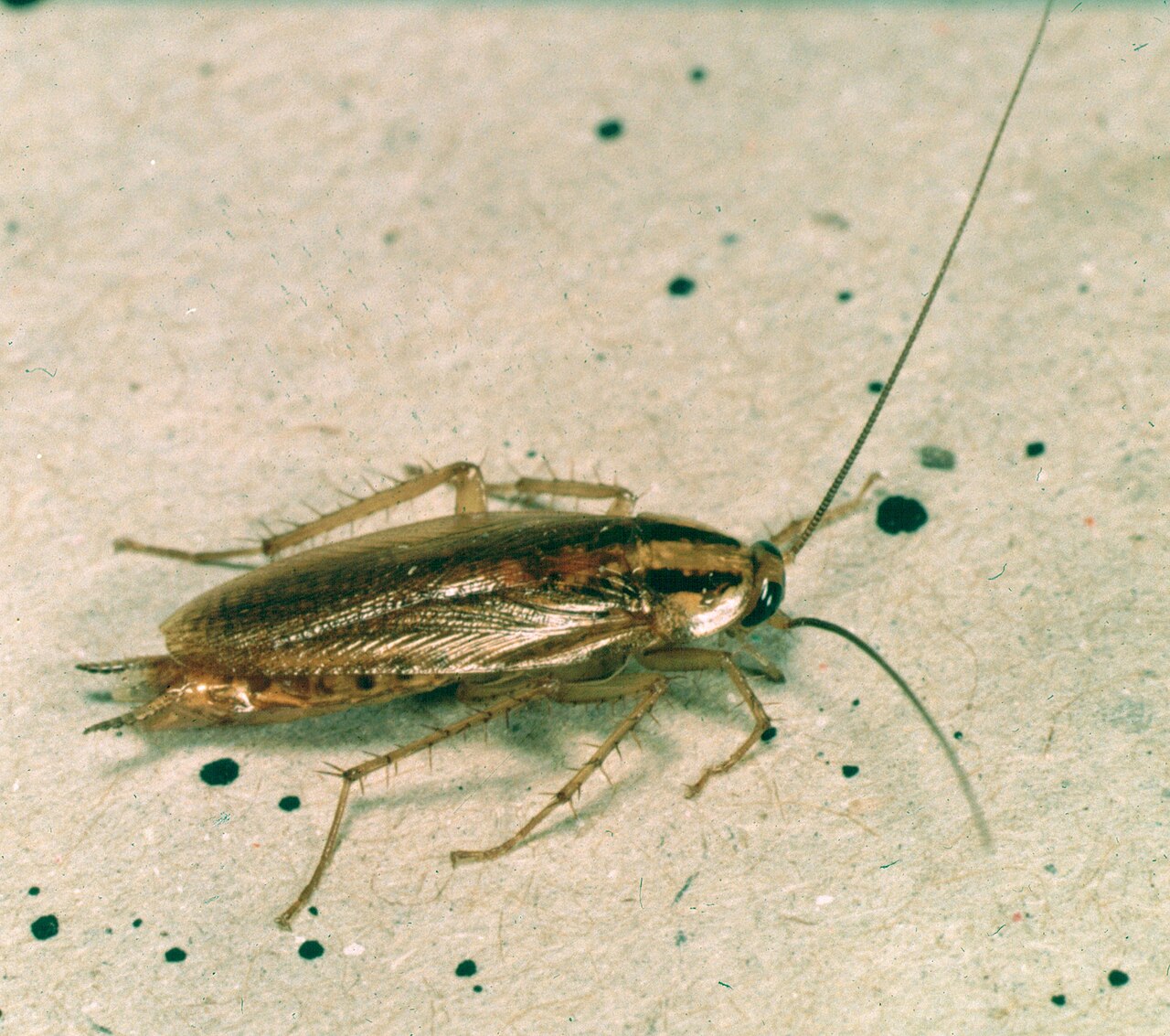
Step 1: Identify which roach you have
UC IPM's cockroach pest note lists five species commonly regarded as pests, and splits them by lifestyle rather than by appearance: German and brownbanded cockroaches live and breed entirely indoors, while American, oriental and Turkestan cockroaches live outdoors and invade buildings temporarily. That split is the most useful fact in this guide. An indoor breeder needs a colony-level treatment inside the kitchen. An outdoor invader needs exclusion and a fix to whatever is letting it in.
| Species | How to recognise it | Where it lives | What that means for treatment |
|---|---|---|---|
| German Blattella germanica | About 1/2 inch; tan to light brown; two dark parallel stripes on the shield behind the head | Indoors only — kitchens and bathrooms, warm (70–75°F) and humid, close to food and water; severe infestations spread through the building | Colony treatment: gel bait plus IGR, repeated. The hardest species to clear and the one that reinvades from neighbouring units |
| Brownbanded Supella longipalpa | About 1/2 inch; males golden tan, females darker brown; both show light-coloured bands across the abdomen, wings and sides of the shield behind the head | Indoors only, and warmer than German roaches (they prefer about 80°F) but not tied to food areas — inside or near electrical appliances, behind artwork on walls, in hollow furniture legs, in clutter | The hardest species to reach with bait, per UC IPM: place monitors and dusts at appliances, wall art and furniture, not only at the kitchen floor |
| American Periplaneta americana | The largest of the common species, up to about 2 inches; reddish brown; adults can glide or fly short distances | Outdoors and in sewers, storm drains, steam tunnels and water meter boxes; forages into ground floors when pipes are damaged, screens are missing or drain traps are faulty | Treat the entry: drains, sewer connections, crawlspace vents. It can carry Salmonella and Shigella, so kitchen surfaces matter |
| Oriental Blatta orientalis | About 1 inch; very dark brown to black; slow-moving; does not fly and cannot climb smooth vertical surfaces | Cool, dark, damp places — garages, basements, water meter boxes, drains, woodpiles and ground cover | Fix the damp and seal door sweeps; baits in drains, voids and masonry enclosures |
| Turkestan Blatta lateralis | Females resemble oriental roaches but carry cream markings behind the head and around short, rounded wings; males are smaller than American roaches with yellowish-beige wings | Outdoors — water meter boxes, cracks between concrete slabs, compost, leaf litter, potted plants, sewers; displacing oriental roaches in warm, dry regions | Exterior baiting at utility boxes and the perimeter; indoor spraying rarely resolves it |
Not sure? The Pest ID Wizard walks you through size, colour, and where you saw it. Sticky traps are the other identification tool worth using: UC IPM recommends placing them along wall edges and under appliances, then checking daily until you can tell where the most roaches are being caught. For a deeper visual reference, the University of California's cockroach pest note has close-up photos of each species.
Step 2: Cut off what they need
German roaches can bounce back from bait alone if food and water stay available. UC IPM's point is blunt: pesticides alone will not solve a cockroach problem, and even tiny crumbs or liquids attract them. Before and during any treatment:
- Fix leaky pipes and dry out sinks overnight — roaches can live weeks on moisture alone.
- Store food in tightly sealed containers, and put pet bowls away after feeding.
- Clean grease from stovetops and the gap behind the refrigerator — a warm, greasy void is prime harbourage.
- Vacuum cracks and crevices rather than only sweeping floors; crumbs in a 1/16-inch gap are still food.
- Remove paper and cardboard piles. Paper is both food and shelter, and cardboard boxes are the classic way an infestation arrives with a delivery.
- Seal cracks in cabinets, walls, baseboards and around plumbing — UC IPM notes an adult German roach can hide in a crack just 1/16 inch wide, and nymphs use smaller ones.
This sanitation phase is why infestations "come right back" after spraying. Sprays kill the visible roaches; bait plus sanitation kills the colony.
Step 3: Choose your treatment — and use it in the right order
The professional sequence, adapted for homeowners. Note the expectation-setting in the third item: none of this is instant, and a product that promises same-day clearance is usually a repellent spray that scatters the population.
- Gel bait first. Pea-sized dabs under sinks, behind appliances, inside cabinet corners and along the hinges of cupboard doors. Roaches carry it back and feed the nest. UC IPM states plainly that when insecticides are used, baits provide better control than sprays — and that it may take 7 days or longer before you see fewer roaches.
- IGR (growth regulator) second. An IGR such as hydroprene or (S)-methoprene stops nymphs from reaching breeding age and collapses the cycle. It works slowly — expect 4–8 weeks before the population curve turns.
- Dusts for voids. Boric acid or a desiccant dust lightly puffed into wall voids, under the refrigerator, behind outlets. UC IPM calls this very effective if the material stays dry and undisturbed — which is the whole catch, and why a heavy layer in a damp cabinet fails. Less is more.
- Sticky monitors throughout. These are your progress dashboard and your identification tool: when traps stay empty for two consecutive weeks, you are done.
Avoid total-release foggers ("bug bombs") and aerosol sprays. UC IPM's guidance is that foggers, bombs and aerosols can be hazardous and may repel and disperse cockroaches into other areas without killing them, and that sprays do not provide long-term control. The EPA's fogger guidance makes the same point from the regulatory side.
Step 4: Know what it costs
DIY supplies run about $25–60 for a bait, IGR and dust kit. Professional German-roach cleanup averages $150–400 for a single treatment, with multi-visit programs for heavy infestations running higher — and in multi-unit buildings the honest answer is often that the whole building needs treating, not one kitchen.
If you are weighing DIY against calling an exterminator, run your details through the roach reproduction calculator — it estimates how fast a population grows while you wait — and the DIY vs Pro calculator compares the money side.
Why German roaches outrun every other species
The reproduction numbers explain the discipline the treatment plan demands. UC IPM describes the female German cockroach carrying a light beige egg case about 1/4 inch long, containing roughly 30 young, dropped one to two days before hatching — sometimes hatching while she still carries it — with a new case every few weeks. The note calls it the fastest reproductive cycle of the common pest cockroaches: a single female and her offspring can produce more than 30,000 individuals in a year.
That is why one missed harbourage matters, and why "I sprayed and they came back" is the normal report rather than a product failure. It also sets the monitoring horizon: with an egg case hatching in about a month and favourites hiding in 1/16-inch gaps, two quiet weeks on the traps is the earliest defensible finish line.
Why they keep coming back
Three reasons, in order of frequency: (1) untreated neighbours — in apartments, German roaches travel through wall voids and plumbing chases; (2) the bait was never enough — a two-minute bait job on a six-week infestation cannot reach the colony; (3) the source was never fixed — a drain, a leak, a delivery of used appliances. For American roaches, check drain traps and roof-to-crawlspace entry points. For oriental roaches, seal basement door sweeps and fix exterior water sources. For brownbanded roaches, look up: they are the species most likely to be living in furniture and shelving rather than under the sink.
Roach allergens and asthma
This is the health reason not to treat an infestation as a cosmetic problem. UC IPM describes indoor cockroach infestations as important sources of allergens and a risk factor for asthma in children, especially in multi-unit housing, with allergen levels directly correlated to cockroach density and to the conditions that allow heavy infestations — housing disrepair and poor sanitation.
The CDC's asthma guidance adds an operational wrinkle that changes product choice: it lists cockroaches and other pests among common asthma triggers, recommends removing water and food sources, sealing cracks, and storing food airtight — and specifically says to avoid using sprays and foggers, as these can cause asthma attacks. In a household with asthma, baits, traps and dusts in sealed voids are the safer route, and a professional should do the application.
When to call a professional immediately
Call the same week if: you see roaches in daylight (a sign the population outgrew its hiding places — grade the full picture with the roach severity quiz), you live in a multi-unit building with spread to several units, or anyone in the home has asthma that worsens near the kitchen.
Three product questions, answered without the marketing
Boric acid around pets. In a thin layer inside wall voids it is far safer than spray residues, but keep pets from licking treated areas and never apply it where food is prepared.
Electronic repellers. No peer-reviewed evidence supports ultrasonic repellers against roaches. Skip them; they cost money and change nothing.
Time to a roach-free kitchen. A light German roach problem typically clears in 2–4 weeks with bait and sanitation; heavy infestations take 6–12 weeks of consistent monitoring. If a product promises clearance in days, it is a repellent, and the colony is still there.
Next steps
Identify your roach with the Pest ID Wizard, model the population with the roach reproduction calculator, and see what a professional would cost with the DIY vs Pro calculator. The roach species comparison goes deeper on telling them apart, and the tiny black bugs guide covers the nymphs people often mistake for a different insect entirely. If wood damage is part of the picture, rule out termites with the wood decay vs termite checker.
Sources: University of California Statewide IPM Program, Pest Notes: Cockroaches (the indoor-breeding versus outdoor-invading split, the half-inch crack and nymph harbourage, the German egg case and the 30,000-per-year figure, bait over spray and the 7-day expectation, dust performance in dry undisturbed voids, foggers dispersing rather than killing, and the allergen and childhood-asthma link); US EPA, Foggers (why total-release foggers are not a routine roach solution); and CDC, Controlling Asthma (cockroaches as an asthma trigger and the explicit warning against sprays and foggers in homes with asthma).