Start here: three questions that separate them
Before anyone sprays anything, answer these — they narrow five candidates to one:
- Where is it? Wet rooms, plant saucers, and basements point to moisture pests. Fabrics, closets, and carpet edges point to fabric pests. Pets and sleeping areas point to blood feeders.
- How does it move? Jumping when disturbed = springtails. Running quickly with a flat, louse-like shuffle = booklice. Very slow, almost crawling dots on a sunny wall = clover mites. A fast, sideways-squashing hop onto a passing pet or ankle = flea. A tiny larva with bristles = carpet beetle.
- Does it bite you? Only fleas on this list bite people — everything else is a nuisance or a fabric pest.
The five candidates at a glance
| What it is | Size you'll see | Where it shows up | Bites? | Real damage |
|---|---|---|---|---|
| Springtail (Collembola) | 1–2 mm in homes (some species up to 10 mm outdoors) | Bathroom floors, sinks, plant saucers, damp concrete, basements | No | None to people, pets, or fabrics — a moisture indicator |
| Booklouse (psocid) | 1–2 mm, flattened, wingless | Bookshelves, cardboard boxes, damp pantry shelves, wall voids near humidity | No | Feeds on mold, not on your belongings; can spot cardboard |
| Carpet beetle (larva or adult) | Larva 4–5 mm with bristles; adult 2.8–5 mm, oval, dark brown to black (black carpet beetle) or mottled white/brown/black (varied carpet beetle) | Carpet edges, under furniture, closets, baseboards, air ducts | No | Larvae eat wool, silk, fur, feathers, hair, felt and stored food |
| Clover mite (Bryobia praetiosa) | Under 1 mm; looks like a walking speck of dust or brick dust | Sunny south- and west-facing walls, windowsills, near lawns | No | Plant feeder; red-brown smears when crushed |
| Flea (usually cat flea) | 1.5–3 mm, dark reddish-brown, flattened side to side | Pet bedding, carpet near pet resting spots, socks and ankles | Yes — itchy bites, often in clusters on ankles | Can transmit flea-borne typhus, plague and cat scratch disease |
Springtails: the jumpers in the bathroom
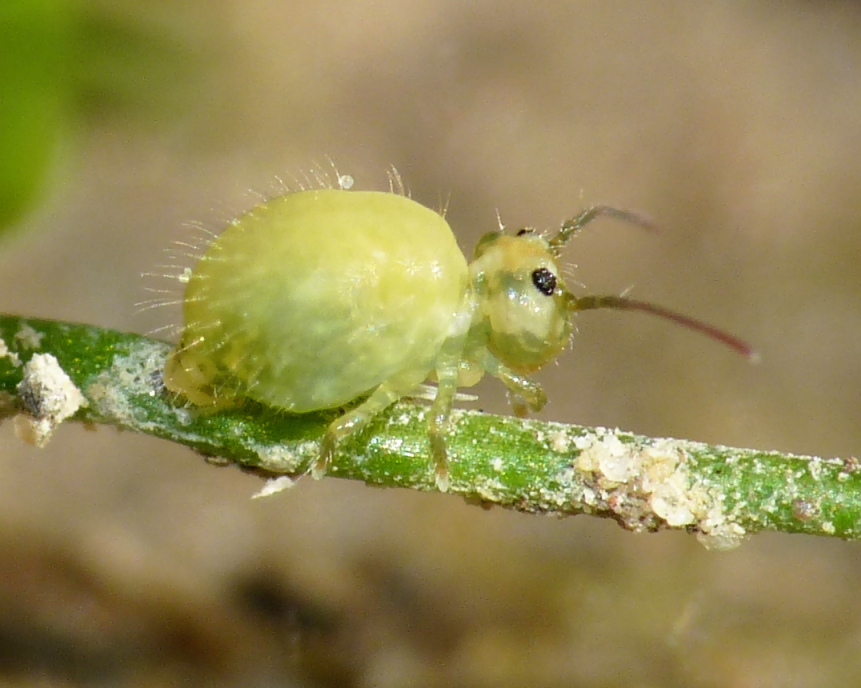
Springtails (order Collembola) are the most common answer to "what are these tiny black bugs in my bathroom?" They range from 0.2 mm to 10 mm across all species, but the ones that wander indoors are typically 1–2 mm — small enough to look like pepper on the tile (Penn State Extension). Their giveaway is a forked appendage called a furcula folded under the abdomen, which snaps down and launches the insect roughly 100 times its own body length. If the speck disappears the instant you reach for it, it is a springtail. Colour is no help for identification — the group runs from white to black and includes purple, red, orange, grey and mottled species — so go by shape, size, and the jump.
They feed on fungi and the liquid films in damp organic matter — never on blood, skin, or fabric. Penn State Extension notes indoor invasions usually follow extended droughts or prolonged saturating rains: the soil dries out or floods, and the population migrates looking for moisture. That is why a springtail sighting is really a humidity report about one specific spot — a leaking pipe, a plant saucer left full, a dehumidifier that stopped running, or a shower that never dries out between uses.
What works: find and dry the wet area. Fix the drip, move the plant off the saucer, run a fan or dehumidifier until the surface stays dry, and vacuum up the stragglers. Insecticide is unnecessary — with the moisture gone, they cannot survive, and they never establish a breeding population indoors.
Booklice: the mold-eaters behind the boxes
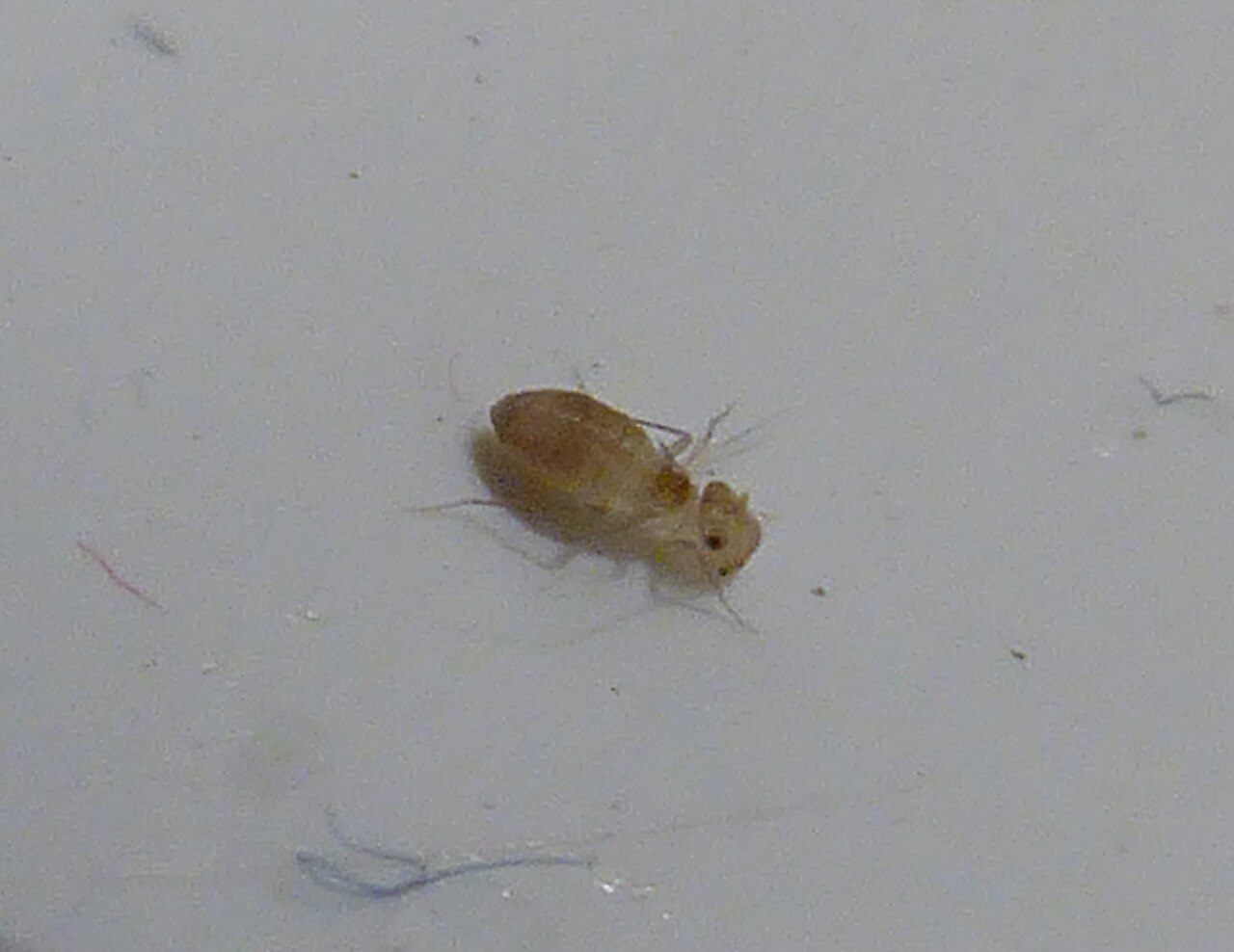
Booklice — also called psocids — are 1–2 mm, soft-bodied, wingless, and flattened so they are wider than they are thick. Penn State Extension describes them as "indicators of high humidity or moisture," because their food is literally the microscopic mold growing on damp paper, cardboard, and drywall paper (Penn State Extension). They do not bite and they do not eat the paper itself.
One reason booklice worry people: a flattened 1–2 mm insect near a bed can look like a bed bug. It is not — the extension fact sheet points out bed bugs are larger and rounder, and newly hatched bed bugs are only about the size of an adult booklouse. If you found the insect under the mattress or along the bed frame's seams rather than on a damp bookshelf, check the bite pattern first with the bed bug vs mosquito bite guide.
What works: drop indoor humidity to roughly 50% or below, ventilate the room, and remove moldy cardboard and damp paper. Booklice populations collapse when their food source dries out; spraying is cosmetic.
Carpet beetles: the larvae that eat wool and silk
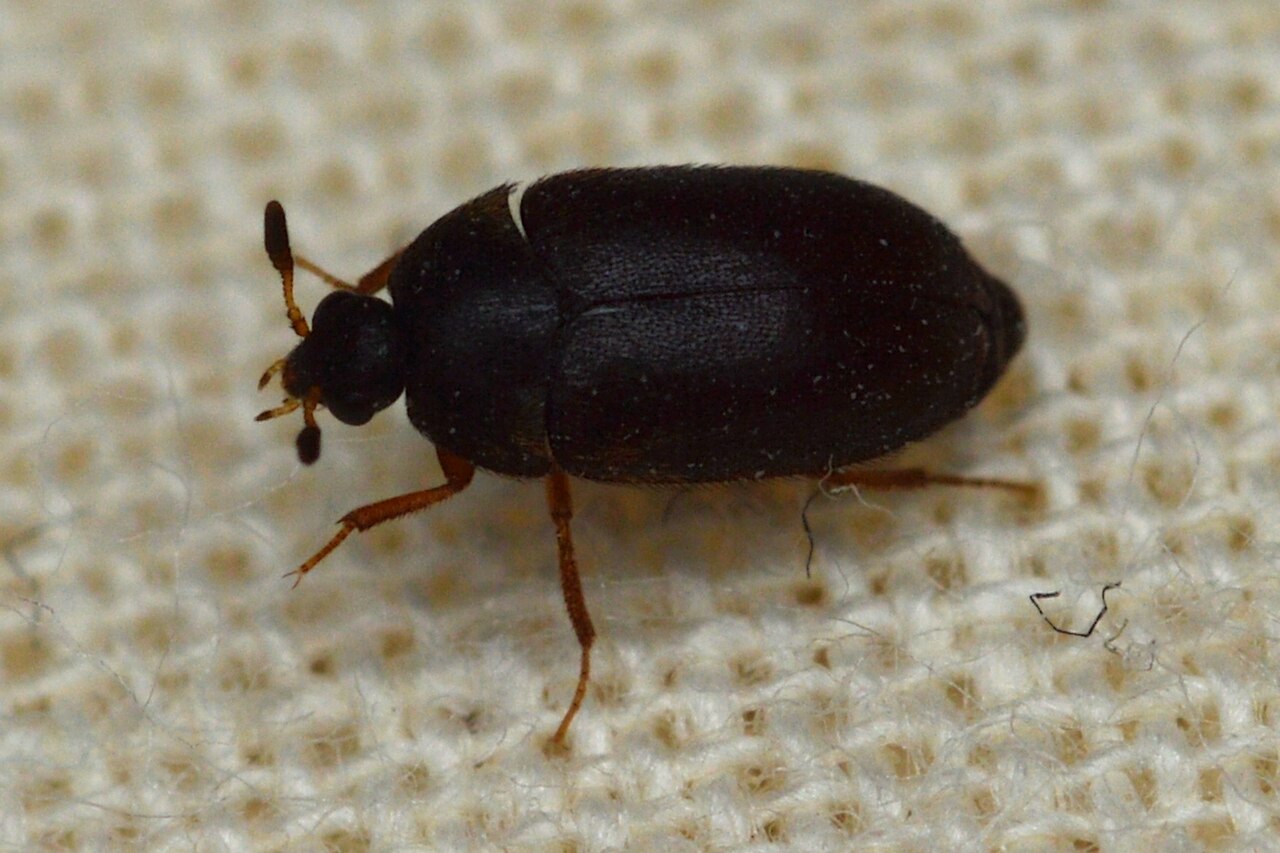
Carpet beetles are the one entry on this list that genuinely damages your home's contents, and it is the larva — not the adult beetle — doing the eating. Ohio State University Extension's carpet beetle fact sheet lists the menu plainly: wool, fur, feathers, hair, hides, silk, velvet, felt and bone, plus seeds, grain, cereals, flour, and even pet food (Ohioline HYG-2103). Larvae crawl from room to room, live behind baseboards and moldings, and inside heating ducts, dresser drawers, carpets, and furniture — with visible damage most often under heavy furniture and along carpet edges, where a vacuum rarely reaches.
The adults are the small mottled beetles that show up at windows and light fixtures. Ohio State notes adults fly readily in May and June and are attracted to night-lights, which is why the beetles appear at windows in late spring, and why the larvae turn up indoors weeks later.
What works: thorough vacuuming — edges, under furniture, closets, inside drawers — plus laundering or dry-cleaning infested woolens, and sealing stored clothing in airtight containers. Pay attention to where bird and rodent nests or dead insects collect near the structure: those are the classic reservoirs.
Clover mites: the moving specks on sunny walls
Clover mites (Bryobia praetiosa) are plant feeders that occasionally invade homes in enormous numbers — and they are the reason a sunlit windowsill can look like it is sprinkled with brick dust. Penn State Extension is direct about them: they "do not attack people," will not reproduce indoors, and "will perish shortly of their own accord" (Penn State Extension). Crushing one leaves a red-brown smear, which is where the "brick dust" comparison comes from.
The same fact sheet notes infestations track lawn vigor — heavy fertilization and a lawn that runs right up to the foundation are the two factors most associated with the mites coming inside, especially in spring and fall when the lawn is growing fastest.
What works: wipe them up with a damp cloth (no insecticide needed indoors), and create a dry, vegetation-free strip of gravel or mulch 12–18 inches wide between the lawn and the foundation wall. The mulch calculator sizes that border for you.
Fleas: the only bites on this list
Fleas are small, dark, blood-feeding insects — and unlike everything above, they bite people. The CDC counts more than 2,500 flea species worldwide, with more than 300 in the United States, though only a few affect human health: the cat flea, dog flea, ground squirrel flea, and Oriental rat flea (CDC). Bites are itchy and often clustered on ankles and lower legs; in the U.S. fleas can carry the organisms behind flea-borne typhus, plague, and cat scratch disease.
A "tiny black bug" near a pet bed that jumps rather than scuttles is almost always a flea. Test it without touching the insect: walk through the area in white socks. Fleas jump onto socks, and the dark specks plus red-brown stains show up clearly against the fabric.
What works: treat the animal and the environment together. That means a veterinarian-recommended flea product for every pet in the house, plus washing pet bedding in hot water and vacuuming carpets, upholstery, and floor cracks daily for at least a couple of weeks (vacuum bags or canisters emptied outside). Skipping the pet treatment leaves the source intact — which is why indoor-only pets still get fleas. Check what is safe to apply around a dog or cat with the pet safety checker before choosing a product.
What actually fixes a "tiny black bug" problem
Four of the five candidates share one root cause: moisture. Springtails, booklice, carpet beetles, and (in a different way) clover mites all respond to the same fixes:
- Dry the room out. Target indoor humidity near 50%; a hygrometer costs less than a single pest-control visit and tells you whether you have fixed anything. Fix drips, clear condensate lines, ventilate after showers and cooking.
- Remove their food. Cardboard, damp paper, spilled pet food, and lint behind appliances feed mold, booklice, and carpet beetles alike.
- Vacuum like you mean it. Carpet edges, under furniture, baseboard gaps, closets, and the inside of drawers. Bag or bin the contents outside.
- Check the perimeter. Clover mites and carpet beetles come in from outside; a dry, vegetation-free border plus tight door sweeps and window screens cuts arrivals.
- Track what you find. Record dates, rooms, and counts in the IPM treatment log — a two-week record usually shows whether the population is falling, which is the evidence that decides between "keep vacuuming" and "call a professional."
You can usually skip professional treatment. These are all surface or moisture pests, not structural wood destroyers: none of them is a termite, and none of them requires fumigation. The exception is fleas — a bad infestation in a multi-room carpeted house is often worth one professional treatment alongside the veterinary plan.
When it is not on this list
Two quick cross-checks before you settle on an answer:
- Bugs around houseplants or flying up from soil — that is the fungus gnat story, covered in Do Gnats Bite?
- Small dark insects in the kitchen, especially at night, that scatter when the light comes on — compare with roach nymphs in the roach elimination guide, and check the population trajectory with the roach reproduction calculator.
- Specks on the mattress seam, or bites in lines of three — stop treating the room and read How Long Do Bed Bugs Live before buying anything.
If the insect still does not match, the free pest ID wizard walks the same questions — size, shape, location, movement — and narrows it to a species you can then verify against a photo.
The bottom line
A pinhead-sized bug on an indoor surface is rarely a health emergency. Jumping specks in a damp bathroom are springtails; flat pale specks on damp paper are booklice; bristly larvae along carpet edges are carpet beetles; dust-like crawlers on sunny windowsills are clover mites; and the ones that actually bite — usually near a pet — are fleas. Identify before you spray, fix the moisture and the food source, and log what changes over two weeks. That sequence solves four of the five problems without a single chemical application.
Sources for this guide: Penn State Extension (springtails, booklice, clover mites), Ohio State University Extension Ohioline HYG-2103 (carpet beetles), and the U.S. Centers for Disease Control and Prevention (fleas).