Identify it before you touch it
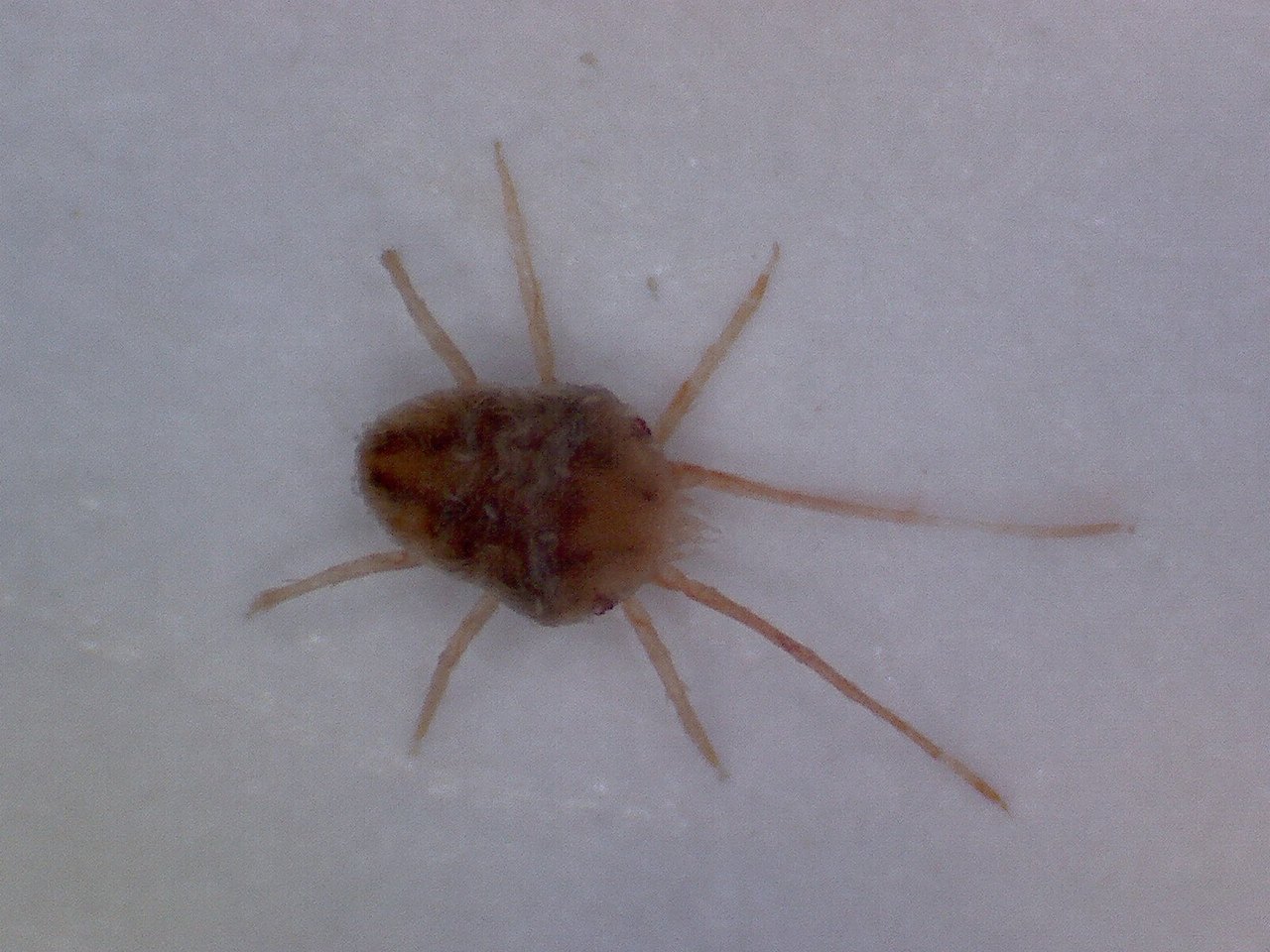
Clover mites (Bryobia praetiosa) are arachnids, not insects — they are closer relatives of ticks and spiders than of any beetle or fly. Three details separate them from everything else that shows up as a moving speck indoors.
- Count the legs. Eight legs, with the front pair roughly twice as long as the others and held straight out in front. Most people read those front legs as antennae, which is why so many clover mites get reported as "tiny red ants."
- Look at the colour and pace. Rusty red, brown, or dark olive-green, about 0.75 mm — under 1/30 inch, smaller than a pinhead — and moving in a slow, unhurried crawl rather than a scuttle.
- Note where it is. Migrating clover mites appear in numbers on the sunniest exterior surfaces: south, southwest, and east walls, window sills, and foundation ledges.
The clover mite ID card
| Feature | Clover mite |
|---|---|
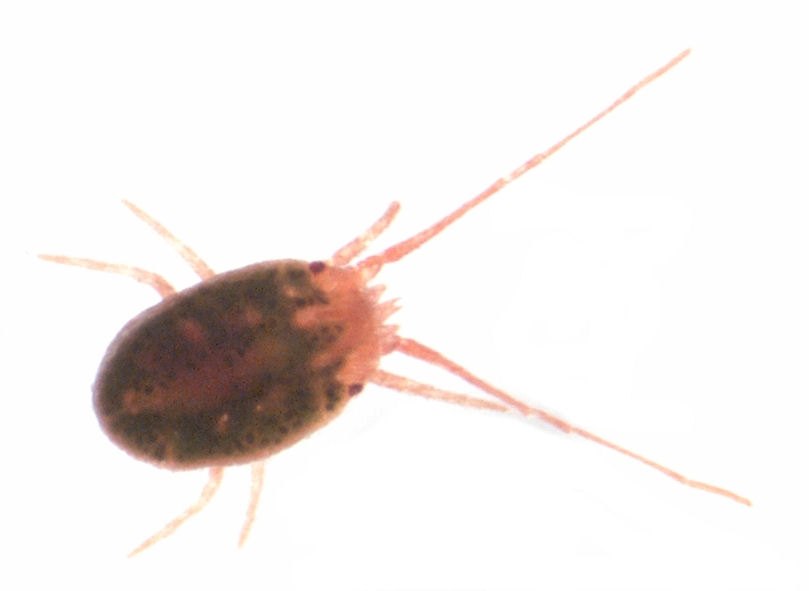
| Length | 0.75–0.85 mm (about 1/30 inch) — smaller than a pinhead |
| Colour | Rusty red, reddish-brown, or dark olive-green with paler orange legs |
| Legs | Eight; front pair about twice the length of the rest, held forward antenna-like |
| Movement | Slow, deliberate crawl in groups — often described as "walking dust specks" |
| Does it bite? | No. It also does not transmit disease or feed on furnishings or pantry food |
| Survives indoors? | A few days at most — they cannot reproduce indoors and die of dehydration |
| Season | Mid-April to mid-June, and mid-October through December; most active at 50–75°F |
The size and colour data above come from Ohio State University Extension's clover mite factsheet (HYG-2095) and the University of Florida's Featured Creatures profile (EENY-437), which both put adults in the 0.75–0.85 mm range with the elongated front legs as the single most useful field character.
If you were bitten, it was not a clover mite
This is the most common misdiagnosis we see around clover mite season, because the evidence looks convincing: itchy skin, and rusty red marks on the sheets and the wall. Both have a different cause. Clover mites neither bite people nor animals — Ohio State Extension is explicit that they "do not bite humans or animals, transmit disease, nor feed on household furnishings or pantry supplies." The red marks are the mites' own body contents.
If you have genuine bite marks in lines or clusters, work the pattern rather than the calendar: the bed bug bites vs mosquito bites comparison covers the sleeping-hours pattern, and if the "bites" are on skin that was never exposed overnight, carpet beetle hairs are a documented mimic — the carpet beetle larvae ID guide covers that side-by-side check. Small dark specks that jump instead of crawl are springtails, which the tiny black bugs guide narrows down.
Why crushing them is the expensive move
A crushed clover mite leaves a smear that Ohio State describes as a green stain with red-orange marks — highly visible on white linens, wallpaper, woodwork and painted siding. Clemson University's HGIC notes the stain is difficult to remove from fabric or walls. In other words, the standard reaction (wipe them off with a hand or a cloth) is the one action that converts a nuisance into damage.
- Never squash them. Lift them with a damp cloth and rinse it, or use a soft brush and take the mites outside.
- Vacuum instead. A vacuum with a crevice tool collects live mites without bursting them. Seal the bag or canister contents in a plastic bag before disposal, because mites can escape a sweeper bag when the machine switches off.
- Skip indoor sprays. Penn State Extension's position is that chemical treatment inside is unnecessary: the mites will die indoors within a few days from dehydration.
The calendar is the whole story
Clover mites are cool-season pests with an unusual trick: they overwinter as eggs and then shut down for the hottest part of summer. That produces two invasion windows a year, and nothing you do in July will change either of them.
| Season | What the mites are doing | What you will see |
|---|---|---|
| Spring (mid-April – mid-June) | Overwintering eggs hatch when temperatures pass about 45°F; young feed on turf and clover | The biggest indoor migration of the year, concentrated on sunny walls |
| Summer | Once daytime temperatures regularly exceed 85°F, females lay oversummering eggs and the population goes dormant (aestivation) | Activity largely stops; cool, wet summers can keep them going instead |
| Fall (mid-Oct – December) | A second generation completes; females lay overwintering eggs as night temperatures drop below freezing | Thousands congregating on vegetation and foundation walls, then working into siding and casings |
| Winter | Eggs sit in cracks, mortar joints, under bark and between wall voids; adults stir whenever the temperature rises above freezing | Sudden mid-winter activity during warm spells, especially in southeastern states |
One generation takes roughly a month outdoors (two to three weeks per Ohio State), and fall and spring populations each run through two or more generations — which is why populations rebuild so quickly after a treatment. Females lay about 70 eggs each, and there are no males to worry about: clover mites are parthenogenetic, meaning the entire population is female and every individual develops from an unfertilized egg.
The four-step fix, in order
Work these in sequence. Steps 1 and 2 are the ones that actually keep clover mites out; step 4 is the one most homeowners start with, and the least durable.
- Break the vegetation bridge. Remove grass and weeds along the foundation, leaving a bare strip 18 to 24 inches wide — CSU Extension recommends about three feet where pressure is high. Prioritise the south, southwest and east sides. A band of pea gravel works as well as bare soil, and clover mites will not readily cross loose, dry material.
- Seal the openings. Caulk cracks and gaps in the foundation, mortar joints and around window and door casings, and fit weatherstripping to doors that lack it. Most indoor mites arrive through a gap nobody has looked at, not through the door you use.
- Remove the ones already inside without crushing them. Vacuum with a crevice tool, or lift them with a damp cloth. Seal the sweepings in a bag that goes straight into outside trash.
- Treat the perimeter only if the pressure justifies it. A barrier application to the foundation, exterior walls up to the bottom of first-floor windows and a strip 10–20 feet out into the turf is the standard extension recommendation. Check that the product label lists the site you are spraying, and note CSU Extension's caveat: there are no highly effective chemical controls for clover mites, though products containing bifenthrin or lambda-cyhalothrin are the most likely to help.
One more lever most people miss: water. Clover mites build up in warm, dry areas at the base of sun-exposed walls and around evergreens, and both UF/IFAS and CSU list supplemental watering of those spots as a way to knock populations back. Left entirely alone, a spring invasion ends on its own by the end of May or early June.
What to plant where the lawn currently touches the house
Extension horticulturists repeatedly recommend replacing the foundation strip with plants clover mites find unattractive. The lists below are compiled from the Ohio State, UF/IFAS and Clemson factsheets cited on this page.
| Poor hosts — good for a foundation bed | Known host plants to move away from the wall |
|---|---|
| Geranium, marigold, zinnia, salvia, petunia, chrysanthemum, rose, wallflower | Lawn and turf grasses (especially heavily fertilised lawns), clover, dandelion |
| Juniper, spruce, yew, barberry, arborvitae | Shrub honeysuckle, strawberry, iris, daffodil, shepherd's purse, alyssum, primrose |
Is the lawn damage clover mites — or winter kill?
Clover mite feeding produces small, meandering silver streaks in the blades; heavy populations kill patches of turf outright, and the dead areas look like light brown, irregular blotches that get blamed on winter kill every spring. Two details settle it, both from CSU Extension:
- Where: clover mite injury clusters within about 10 feet of a building, tree, or other upright surface — because the mites periodically climb up to shed their skins and lay eggs.
- When: turf injury appears from February to May and then stops. Patchy browning that develops in the heat of July is a different problem with a different cause.
When it is worth paying someone
Clover mites are one of the few household pests where the DIY path is genuinely cheaper and more effective than a service contract: a barrier strip, some caulk and a vacuum solve most situations for the price of materials. Professional help starts to make sense when mites are entering through wall voids you cannot reach, when the same south wall is re-infested every spring, or when a home is being prepared for sale and the staining cannot be repeated.
Before you sign anything, price both paths with the DIY vs pro calculator, and if you do go with a company, check the contract terms with the pest control contract review tool. If you are unsure what you are looking at, the pest ID wizard drills down from leg count and location, and the seasonal garden defence planner puts the perimeter work in calendar order alongside the other fall invaders. If the specks are larger than dust and shield-shaped instead, you are looking at the other big autumn arrival — the brown marmorated stink bug guide covers that one and the caulking list that stops it. If they are round and orange with black spots, that is the Asian lady beetle guide — same wall, same window, and a much worse stain when crushed. The fourth arrival of the season is not a beetle at all: the cluster fly guide covers the dull-grey flies that gather at the glass on warm winter days, once they are already inside. The third member of the autumn set is the only one that goes after your food supply — the fall mouse-exclusion guide covers the pencil-width gap rule and the CDC seal-up checklist in the same order of work. Log what you find and when with the IPM pest log — two springs of dates is enough to show whether your barrier is working.
Sources: Penn State Extension, Clover Mites; Clemson University HGIC 2414, Clover Mites; University of Florida IFAS, EENY-437 Clover Mite; Ohio State University Extension, Ohioline HYG-2095; Colorado State University Extension, Clover Mites and Other Mites of Turfgrass (5.505).