The 30-second read
- One lesion, no pattern, and a spider you actually saw or felt — believe the spider. Spiders bite defensively when they are trapped against skin; they do not come looking for a meal from you.
- A line, cluster or chain of bites — that is feeding behaviour, and spiders do not feed on people. Look at fleas, bed bugs and mosquitoes instead.
- Red, warm, swollen, spreading, and painful with pus — think infection first, not venom.
- You did not see anything bite you — that is the normal state of affairs. Confirmed spider bites are rare, and the diagnosis is usually made by excluding everything else.
Evidence for a spider, and evidence against one
Read your own skin the way an entomologist would: as a set of clues that either point at a spider or away from one. The CDC notes that spiders are usually not aggressive and that most bites happen because a spider was trapped or touched; the UC Statewide IPM Program adds that the jaws of most spiders are too small to break human skin at all, and that spiders seen out in the open during the day are unlikely to bite anyone.
| What you found | What it points to | Why |
|---|---|---|
| A single red bump, and you felt the bite — rolling over a spider, a shoe or glove left out overnight | Plausibly a spider | This is the exact scenario both CDC and university extension sources describe: a trapped spider defending itself |
| Two tiny puncture marks with pain that spreads to the chest, abdomen or back | A widow spider (black widow group) | CDC lists both the paired puncture marks and the neurotoxic pain pattern as hallmarks of widow bites |
| A stinging bite, then a small white blister in the same spot | Possibly a recluse — only if you are inside the recluse range | CDC describes a stinging sensation with localised pain and a small white blister forming at the site of a brown recluse bite |
| Several bites in a row, in a line or a triangle, mostly on ankles, wrists or the waistband | Not a spider | A spider bites once in self-defence; repeated bites in a pattern are feeding marks — compare them against the bed bug and mosquito signatures |
| A red, hot, spreading, painful swelling that leaks pus and keeps getting worse over 24-48 hours | A skin infection, not a bite | University of Georgia entomologists warn that MRSA is repeatedly mistaken for a spider bite — and the treatments are completely different |
| Tiny red crawling specks near a window or on a concrete wall that leave a red smear when wiped | Neither — and no bite at all | Clover mites look like an infestation and a rash at the same time; see clover mites before you treat anything |
The two spiders worth knowing
Of the roughly 3,000-plus spider species in the United States, the CDC singles out two as medically important: the black widow and the brown recluse. Everything else you meet in a house or garden is either unable to break the skin or produces a reaction no worse than a bee sting — the UC IPM's wording, not ours.
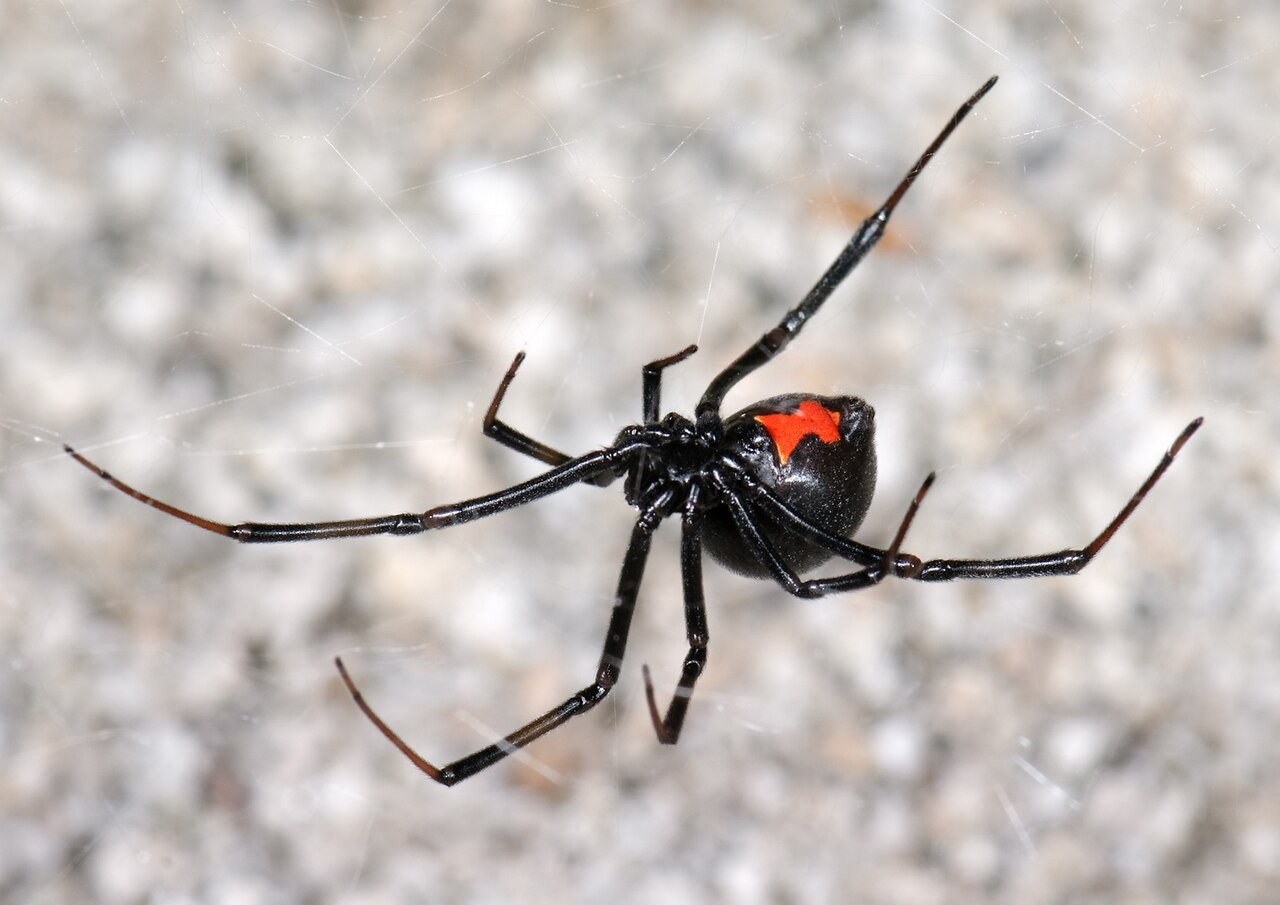
The black widow is a shiny black spider with a red pattern on the underside of a bulbous abdomen. She builds an irregular, tangled cobweb between objects — woodpiles, eaves, fences, patio furniture, the corner of a garage — and bites usually happen when a person reaches into that web or leans against it. The venom is a neurotoxin, and the CDC's description of the effects is specific: pain at the bite itself, then pain that spreads to the chest, abdomen or whole body. Anyone bitten should stay calm and get medical advice rather than wait it out.
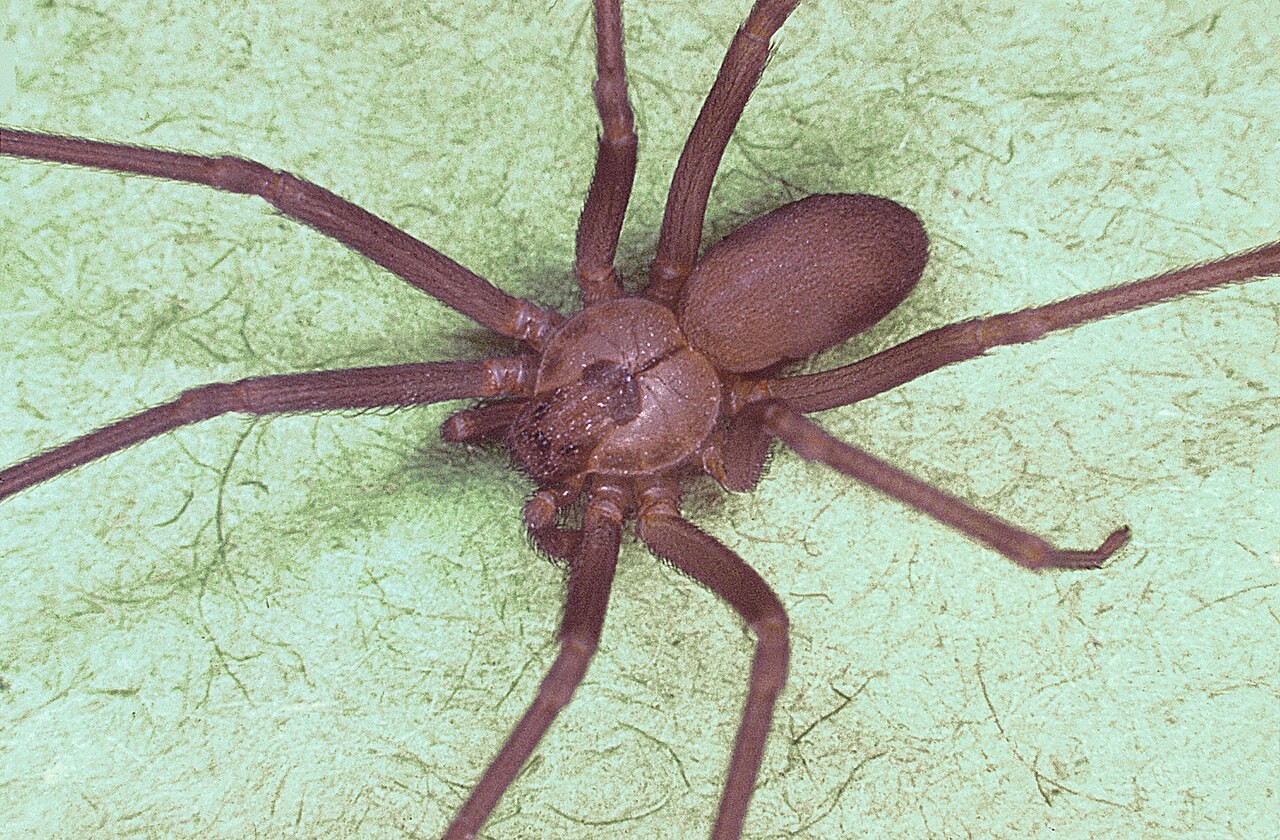
The brown recluse is a uniformly tan-brown spider with a dark violin-shaped mark on the head region and — the detail that actually identifies it — six eyes arranged in three pairs instead of the usual eight. It cannot bite without counterpressure: the spider has to be pressed against skin, which is why the classic story is a shoe or a bed. Most of what you have read about recluse bites being catastrophic is out of proportion with the published numbers, which are covered in the next two sections.
| Feature | Black widow | Brown recluse |
|---|---|---|
| Where | Throughout North America, most common in the southern and western states; woodpiles, eaves, fences, undisturbed debris | Midwestern and southern states; secluded dry shelters — under structures or logs, rock and leaf piles, closets, shoes, attics |
| What it looks like | Shiny black, red marking on the underside of a round abdomen, irregular tangled web | Uniformly tan-brown, dark violin mark on the head region, six eyes in three pairs, body under 3/8 inch |
| How it bites | Usually when a hand or limb contacts the web; two puncture marks are a recognised sign | Needs counterpressure — it cannot bite unless it is trapped against skin |
| What to expect | Pain at the bite that spreads to the chest, abdomen or whole body; neurotoxic venom | Stinging sensation, localised pain, a small white blister; 90 percent of bites cause no reaction or a small bump |
| What to do | Stay calm and get medical advice — CDC's own instruction for anyone bitten | Monitor; seek care for a darkening ulcer or any systemic symptom, which is the under-1-percent case |
Why "brown recluse" is almost never the answer
Penn State Extension publishes the numbers that most internet pages leave out. Roughly 90 percent of brown recluse bites cause no reaction at all or a small red bump about 5 mm across that heals on its own. About 10 percent produce a dermonecrotic lesion — skin that darkens, dries and sloughs over about two weeks, healing in two to four months. Under 1 percent cause systemic symptoms such as hemolytic anemia and acute kidney injury; those are mostly in children and can be fatal within 12 to 36 hours, which is what makes a genuine systemic reaction a true emergency rather than a wait-and-see.
Geography does most of the remaining work. Brown recluses are established in 16 states — Alabama, Arkansas, Georgia, Illinois, Indiana, Iowa, Kansas, Kentucky, Louisiana, Mississippi, Missouri, Nebraska, Ohio, Oklahoma, Tennessee and Texas. Outside that footprint they are almost exclusively hitchhikers inside buildings, carried in with boxes and furniture, so the odds of being bitten by one in a state where they do not live are negligible. UC IPM's California numbers make the point starkly: in a nationwide identification study spanning 2000 to 2005, nearly 600 spiders that people were certain were brown recluses were submitted from California, and exactly one turned out to be a brown recluse — in a house whose family had moved from Missouri.
And the violin mark alone will not settle it. UC IPM states plainly that the presence or absence of a violin marking is not a reliable identification feature, because harmless spiders have dark head markings too, and genuine recluse species in the southwest have almost none. Their test requires all five features together: six eyes in three pairs; a uniformly coloured abdomen covered in fine hairs with no pattern; legs without stout spines; uniformly coloured legs; and a body no longer than 3/8 inch. On that basis, more than 99 percent of the spiders people in California send for identification are something other than a recluse — and the same logic applies anywhere outside the 16-state range.
The misdiagnosis problem runs in both directions
The most honest thing a pest guide can tell you is this: a spider bite is a diagnosis of exclusion. Penn State lists some of the conditions routinely misread as recluse bites — poison ivy, chemical burns, diabetic ulcers — and notes that in one Kansas home, researchers collected more than 2,000 brown recluses over six months and the residents had not been bitten in six years. A house full of recluses is not the same thing as a house with a biting problem.
The reverse error is more dangerous, because it delays real treatment. A "spider bite" that is actually a MRSA skin infection, or a diabetic ulcer, needs antibiotics or wound care — not spider management — and University of Georgia entomologists describe the two being confused by both patients and some clinicians. If a wound is warm, spreading, painful, leaking pus, or getting worse after 24 to 48 hours, treat that as the primary problem and get it looked at.
What to do in the first hour
The CDC's first-aid sequence is short, and none of it involves cutting, suction or home remedies:
- Stay calm and, if it is safe to do so, identify the spider — a clear photo helps a clinician decide whether antivenom or observation is appropriate.
- Wash the bite area with soap and water.
- Apply a cloth dampened with cold water, or filled with ice, to reduce swelling, and elevate the area if you can.
- Do not try to remove the venom — there is no safe way to do it at home.
- Get medical attention for any bite from a spider you believe was a widow or a recluse, or any bite with spreading symptoms.
One follow-up item that gets missed: the CDC recommends keeping tetanus boosters up to date (every 10 years), because a break in the skin — from any cause — is how tetanus spores get in.
When to stop watching and get care now
These are the CDC's listed spider-bite symptoms, and any of them take precedence over identification:
- Difficulty breathing; high blood pressure
- Sweating, fever or chills; nausea and vomiting
- Pain radiating from the bite, muscle pain or cramping; headache
- A reddish-to-purplish colour or a blister at the site
- Anxiety or restlessness
Severe outcomes are rare, but the CDC states plainly that death can occur in the most severe cases — and the Penn State figures narrow that risk to children with systemic symptoms, where the timeline is measured in hours. This is not a category to monitor at home. Our emergency pest triage walks the same decision the other way around: which household pest situations are a today problem and which are a this-week problem.
The spider you just found in the house
If there is no bite — just a spider on the wall — the correct response is usually to leave it alone. UC IPM's guidance is unusually direct: spiders are mostly beneficial because they eat pest insects, pesticides are not generally needed for them, and control is a matter of removing webs and hiding places. Sweep, mop and vacuum regularly, vacuum up the spider and its web, remove clutter indoors and around the foundation, seal cracks in the foundation and gaps around windows and doors, and check screens for good seals. Fixing the screen also keeps out the insects the spider was feeding on.
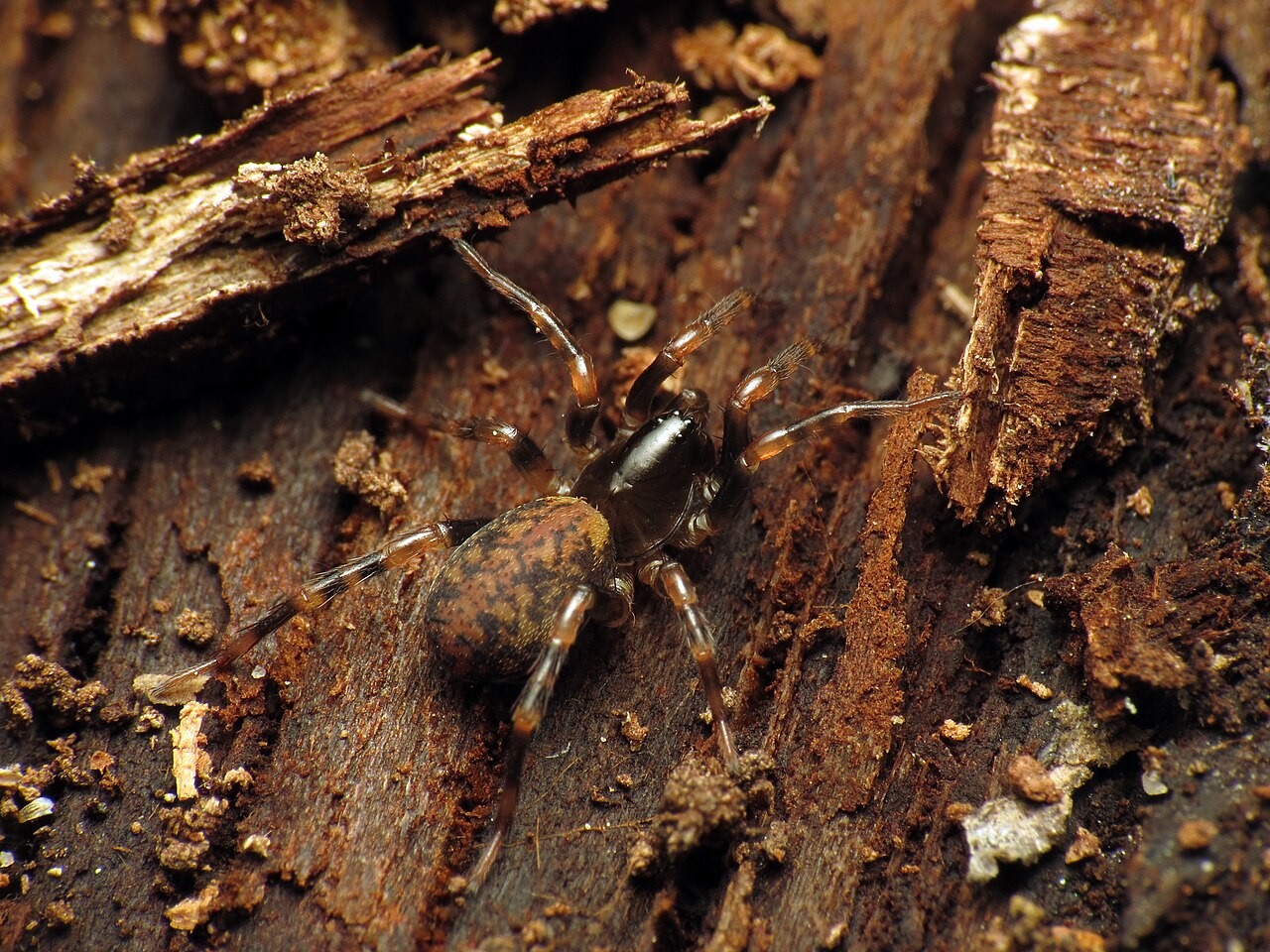
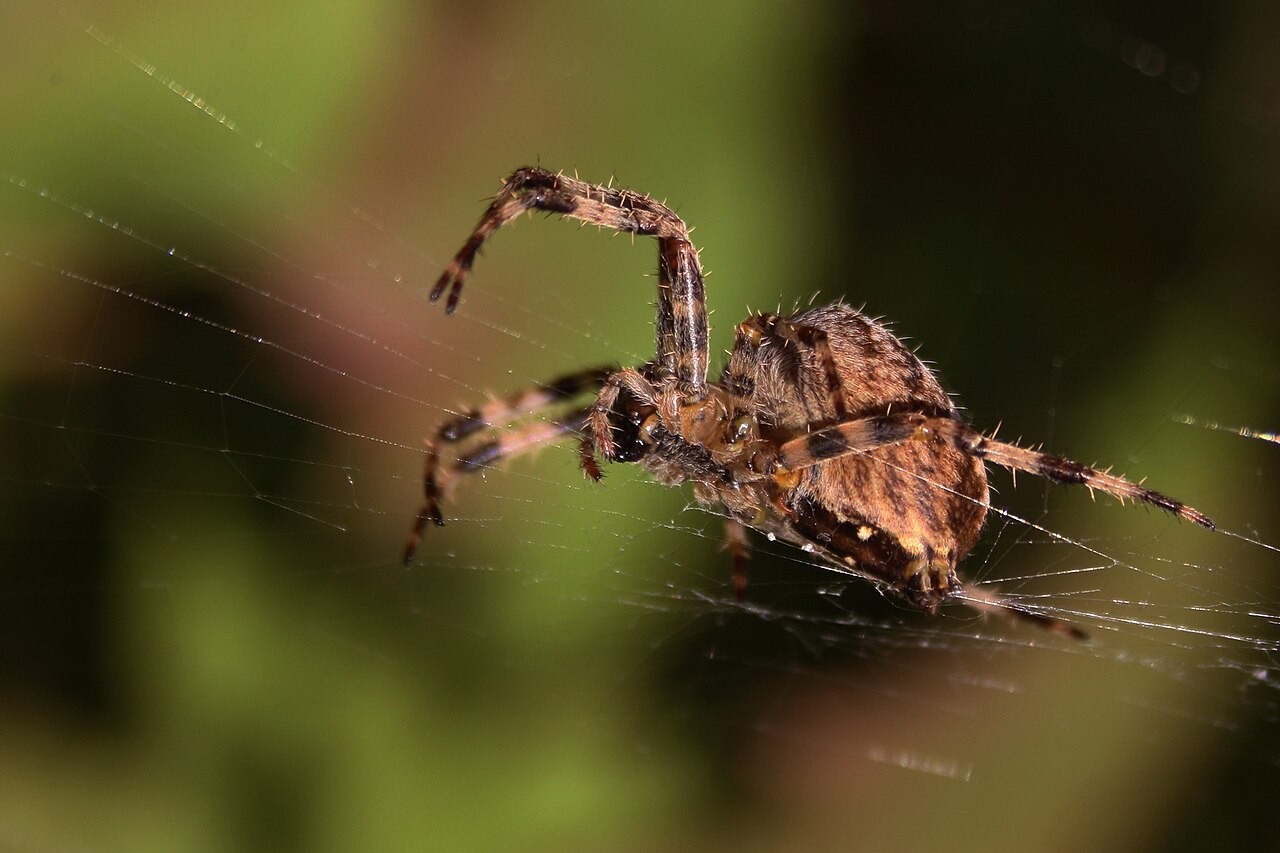
Two of the spiders people worry about most are worth recognising precisely because they are low-risk. Wolf spiders are the large, fast, hairy hunters that run across a floor or a porch at night; they chase their prey on foot, do not build a catching web, and carry their egg sac and then their spiderlings on their backs. Orb weavers are the ones in the big wheel-shaped web between the porch light and the shrub, and they rebuild that web most nights. Neither has any interest in biting a person who is not squeezing them.
If you want a rough answer before you go looking for your phone, the spider venom scale compares the spiders people actually find at home — and the Pest ID Wizard runs the same elimination logic on the animal rather than the wound. For bites and itches that keep recurring in the same room, the tick risk map covers the one common bite that carries a real disease risk, and the beneficial bug matchmaker helps you decide whether the spider in the corner is already doing your pest control for you.
Sources: CDC National Institute for Occupational Safety and Health, Venomous Spiders at Work (widow and recluse identification, symptoms, first aid, prevention, and the tetanus note); UC Statewide IPM Program, Pest Notes: Spiders (most spiders cannot bite through human skin; spiders in the open rarely bite; management without pesticides); UC Statewide IPM Program, Pest Notes: Brown Recluse and Other Recluse Spiders (the five-feature test, the 6-eyes-in-3-pairs rule, the 2000-2005 identification study, and why the violin mark is unreliable); Penn State Extension, Brown Recluse Spiders (the 90 / 10 / under-1-percent outcomes, the 16-state range, the Kansas 2,000-spider house, the misdiagnosis list); and University of Georgia CAES Field Report, "Brown recluse spider isn't typically a Southerner" (MRSA and spider bites confused in both directions).