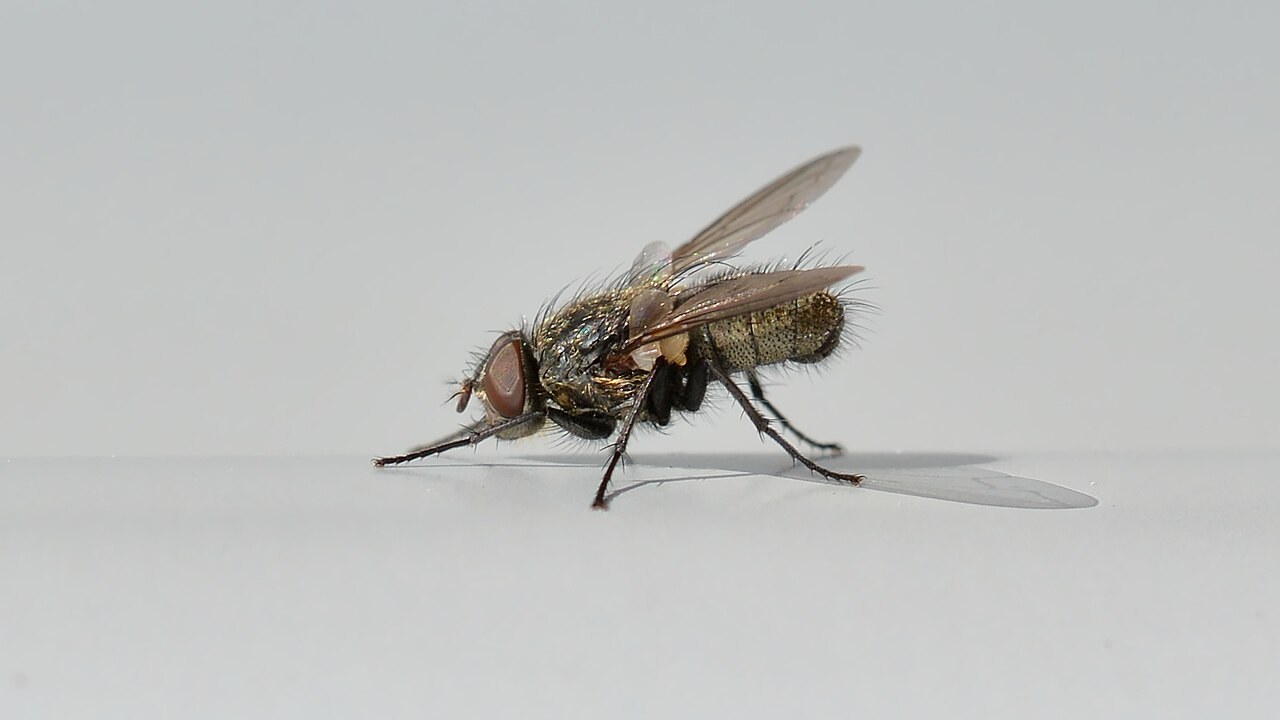
Identify a cluster fly in 30 seconds
You do not need a microscope. Three things separate a cluster fly from the flies you normally deal with in a kitchen.
- Look for gold, not metal. Penn State Extension describes the adult as dull grey with black markings and a covering of golden-yellow hairs on the thorax, dense enough to give the whole fly a golden sheen. Michigan State puts it more practically: it looks like a house fly with a patch of yellow hairs under the wings. A blowfly or a greenbottle is the opposite — shiny, metallic, and bare.
- Watch how it moves. Extension guidance is consistent on this: cluster flies are sluggish in flight and easy to swat or pick up. A house fly overhead is gone before your hand starts moving.
- Note where and when. A cluster fly indoors is almost always at a window, on a warm winter or early-spring day, and usually more than one. House flies indoors cluster around food and waste; cluster flies cluster around glass.
That last detail is the honest limit of a photograph-based ID. The three species blur at a glance, and if the fly is on the kitchen counter rather than at a window, it is worth walking through a structured key before you act on it — the pest ID wizard covers size, shape and location in the same three questions.
The ID table: cluster fly vs house fly vs blowfly
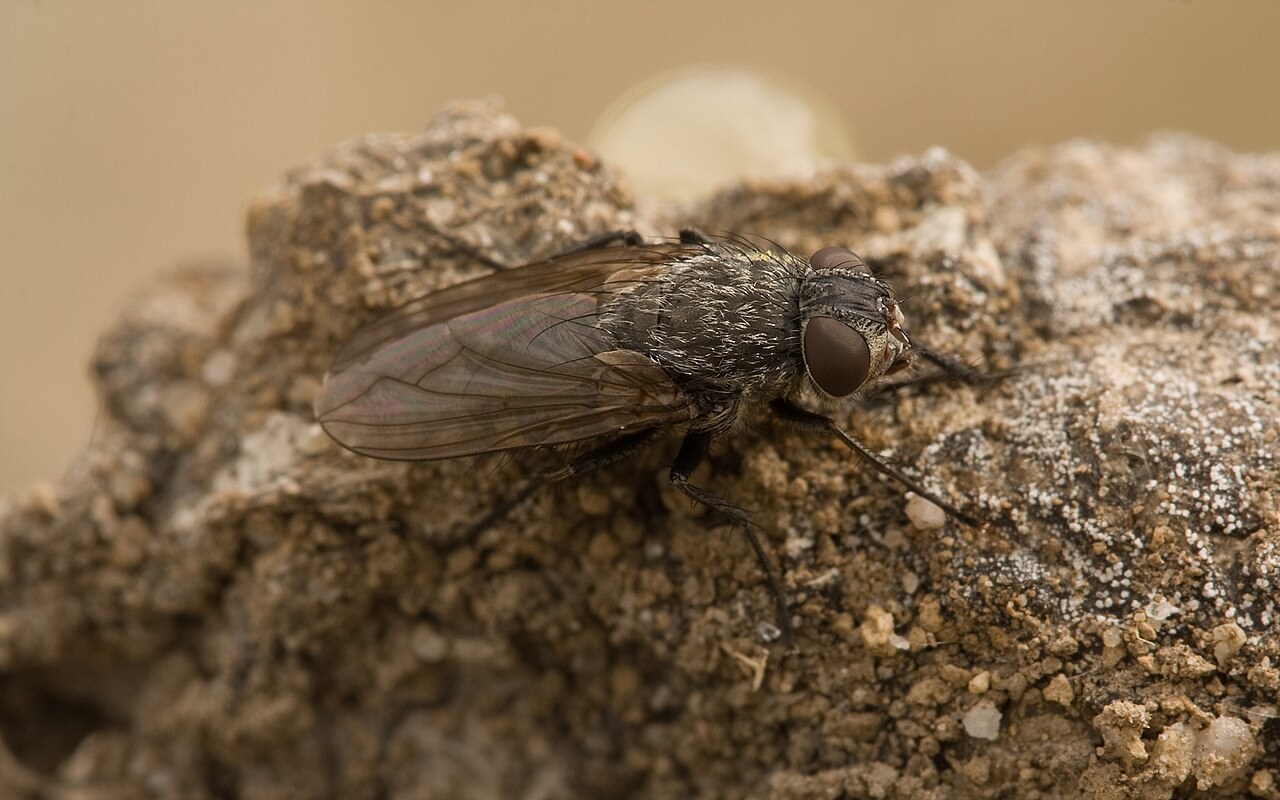
Cluster flies (Pollenia rudis and relatives) are in the same broad family as blow flies, which is why the comparison comes up so often. The three-way split below uses only characters an extension fact sheet actually names.
| Species | What it looks like | Where you find it indoors | What it is doing there |
|---|---|---|---|
| Cluster fly | Slightly larger than a house fly; dull grey with black markings; golden-yellow hairs on the thorax, densest under the body and under the wings | Windows, on warm winter and early-spring days; attics, wall voids and spaces behind siding | Overwintering. It does not feed, bite or lay eggs indoors |
| House fly | Medium grey, four dark stripes on the thorax, no golden hair | Kitchens, bins, anywhere food or waste is exposed | Feeding and breeding. The one that genuinely needs a sanitation response |
| Blow fly / greenbottle | Metallic blue, green or bronze; shiny and bare, no golden hairs | Rarely indoors except where something has died | Developing in carrion — an indoor sighting is a clue, not a nuisance |
| Face fly | Similar to a house fly; stays on the face of cattle in summer | Windows in fall, when it is looking for somewhere to overwinter | Overwintering — same autumn behaviour as the cluster fly |
The face fly is included deliberately: the University of Kentucky fact sheet groups it with the cluster fly as an indoor autumn arrival, so "a fly at the window in October" is not automatically a cluster fly.
Why they are in your walls: the earthworm connection
Cluster flies are not a housekeeping problem, and this is the part that surprises people. Their larvae are internal parasites of earthworms. Adults lay eggs on or near the soil, the maggots burrow into an earthworm and develop inside it, and the worm usually does not survive the encounter. Michigan State notes that eggs hatch in about three days and the full cycle takes four to five weeks; Penn State and UNH Extension both put the seasonal total at three to four or more generations per summer.
So a heavy cluster fly population is a signal about your yard, not your bin. University of Maine Extension is explicit that the fly is "a good indication of a healthy earthworm population nearby" — a wet, worm-rich lawn or garden bed is exactly the habitat the species needs. That also explains why treating the house alone never finishes the job, and why the fly's arrival has nothing to do with sanitation.
What drives the move indoors is the calendar. As the last summer generation matures, the adults leave the soil and search for shelter. Penn State lists the natural equivalents: hedgerows, the space under the bark of dead and dying trees, and the crevices of south-facing cliffs and rock faces. A house is simply a warmer version of the same thing — siding gaps, soffit vents, louvres, window and door frames, wall voids and attics. UNH Extension sums up the whole situation in one line: they are using your home as a place to spend winter, and they cause no damage to the building, the furniture, or you.
What they actually do to a house (the honest damage assessment)
On the nuisance-vs-damage scale, cluster flies land firmly on nuisance — with one indirect exception that is worth knowing before you decide to spray a wall void. Taken together, the extension consensus is:
- No biting and no disease. Families repeatedly state they do not bite people or animals, and are not known to carry diseases of medical importance. They are not attracted to garbage, and they will not touch your food.
- No structural damage and no fabric damage. Michigan State is direct: cluster flies do not harm woolens, fur or feathers, do not infest kitchen cupboards, and do not feed or lay eggs during the winter. There is no indoor generation to stamp out.
- The one real mess is cosmetic. Penn State notes they may leave small dark spots of excrement on windows and walls. In a bad year that is a cleaning job, not a repair job.
- The indirect risk is the carpet beetle. This is the item that changes the management plan. If you dust a wall void and kill thousands of flies inside the wall, you have left a large supply of dead insects; Penn State warns that carpet beetles may then feed on those carcasses and move on to woolens, stored dry goods and other natural products. The carpet beetle guide covers what that becomes if it is allowed to start.
In other words: the flies themselves are a two-week annoyance. A treated wall void can be the start of a pantry and wardrobe problem. That is the trade being made when a fogger comes out.
Why it looks like there are more every day
UNH Extension describes the experience precisely: just when you think you have them under control, more appear the next day, creating the impression that they are breeding in the house. They are not. What is happening is that a wall cavity or attic holds a reservoir of flies that emerge in waves as indoor temperatures fluctuate. The flies that appear on a February warm spell are ones that have been sitting in the void since October — which is why killing the visible ones changes nothing about tomorrow.
The spring version matters too. When temperatures rise, the flies try to leave, but a large share of them take the wrong turning and end up in living areas instead of outdoors. Michigan State describes this as a certainty rather than a possible outcome: whatever got in during the autumn is going to make an appearance on the way out.
The fix that works: seal the building before they arrive
Every extension source consulted for this guide names the same primary control, in almost the same words — mechanical exclusion is the best method when the goal is keeping cluster flies out of a structure. The list of openings is the standard autumn-invader list, because it is the same list a rodent-exclusion job uses:
- Cracks around windows and doors, and gaps under exterior thresholds.
- Loose or poorly fitted siding, and the joint line where siding meets trim.
- Soffit vents, louvres and attic vents — cover them with wire screening.
- Openings where utility pipes and cables pass through the wall.
- Behind chimneys and around chimney flashing, and under the fascia at the roofline.
- Old double-hung windows with pulley openings: MSU's practical fix is masking tape over the opening, which stops flies entering the room along that route.
Two numbers decide whether the work is done in time. UNH Extension puts the deadline at before September 10th for sealing siding cracks and screening attic vents. Michigan State gives the complementary exterior-spray deadline — if a professional is applying a residual to the south and west walls, it should go on by about August 15, while the flies are only beginning to congregate. Both dates exist for the same reason: the congregation is a fixed event on the calendar, and work done after it is work done on the inside of the wall.
There is an interior half to the job as well. Sealing around electrical outlet boxes, switches and light fixtures, and around window and baseboard moulding, keeps flies that are already in the walls from emerging into rooms. That is the difference between a reservoir and a swarm.
What does not work — and what the label says instead
Cluster flies are one of the clearest examples in household pest control of a problem that insecticide genuinely cannot solve. The failure list is specific:
| The move | Why extension guidance says not to |
|---|---|
| Killing earthworms in the lawn to starve the flies | Michigan State: treating yards with insecticides to kill earthworms has not been shown to be effective at reducing the number of flies entering homes |
| Dusting wall voids and attics with insecticide | It kills thousands — and leaves the carcasses that carpet beetles feed on before they attack woolens and stored dry goods. Penn State calls insecticide inside structures after flies are in the voids "not advisable" |
| Aerosol foggers in the attic | They kill the flies amassed in the attic but will not stop flies emerging from wall voids, so they are not a long-term answer |
| Crack-and-crevice sprays where flies appear indoors | Penn State: spraying into cracks will not prevent the flies emerging, and is "not a viable or recommended treatment" |
| Aggressive repeat insecticide treatments | Michigan State: the exposed flies killed are quickly replaced by others emerging from the woodwork, so cost rises and the population does not |
| An exterior residual spray, used alone | It is legitimate — but sunlight breaks the residue down, and Penn State describes effectiveness fading within days to a week or two. It is a supplement to sealing, never a replacement |
If an exterior treatment is going on the house, do the arithmetic on who applies it. Extension guidance is that a residual application of this type belongs to a licensed pest control operator, applied in autumn just before congregation. The DIY versus pro cost calculator prices both routes for this exact situation, and if a professional visit is being considered as an annual arrangement, the pest control contract review lists the recurring-treatment clauses worth questioning before you sign — because in this niche the honest answer to "will an annual plan fix it?" is no.
Getting rid of the ones already inside
When it is too late for the calendar, the extension answer is mechanical removal, not chemical:
- Vacuum them. Flies are sluggish and make little attempt to escape. If you use a vacuum cleaner, UNH Extension's instruction is specific: remove the bag and place it outdoors, or flies inside it will crawl back out into the house.
- Swat the stragglers. Because the flies are slow, a swatter is genuinely effective indoors, and it costs nothing.
- Use flypaper where air is still. Resin strips may be hung in an infested area if there is little or no air movement.
- Seal the interior emergence points while you clear the current wave. Electrical fittings, window frames, baseboard moulding and, in old double-hung windows, the pulley slot.
- Clean the window glass and sills. Not for the flies — for the excrement spots they leave behind, which are the only lasting mark the invasion makes.
A professional is worth considering in one situation: a large, old building with an attic that cannot be sealed, where the flies emerge in numbers every warm spell rather than in one autumn wave. Even then, be sceptical of a guaranteed outcome — Michigan State's guidance is blunt that chances are you will continue to see flies even after professional treatment, and that the realistic goal is reduction, not elimination.
Logging what you see and when is the cheapest way to know whether the sealing worked. The IPM pest log is built for exactly this — a dated record of sightings that turns "there seem to be fewer this year" into something you can actually check.
Your cluster fly calendar
| When | What is happening | What to do |
|---|---|---|
| Late July – mid August | The last summer generation is maturing in the soil around your lawn | If an exterior residual is being applied by a licensed operator, it goes on by about August 15 — the deadline MSU gives, before congregation starts |
| Now – early September | Adults begin seeking overwintering sites; sunny south and west walls are the landing zone | Seal and screen — before September 10th on UNH's schedule. Repair or replace damaged screens too |
| October – November | The main move indoors: voids, attics, behind siding, window frames | Vacuum what you see; do not treat the voids or fog the attic |
| Warm days, December – February | Flies become active inside, emerge at windows, and look like a fresh infestation | Vacuum and swat; check interior seals around outlets, switches, fixtures and trim |
| March – May | Survivors try to leave; many end up in living areas instead of outdoors | Expect a second wave; this is the best two weeks of the year to find and seal the gaps they came through |
Next steps
Cluster flies are one of a group of insects that all do the same thing every autumn for the same reason — they are looking for a winter, and they use the same entry points to find it. If you are finding more than one species at the window, the Asian lady beetle guide covers the October beetle invasion, the brown marmorated stink bug guide covers the shield bug that arrives on the same schedule, the boxelder bug guide covers the red-and-black species on sunny siding, and the clover mite guide handles the tiny red specks that are arachnids rather than insects. Because the sealing list is identical for all of them, the fall rodent-exclusion guide is the natural companion — seal once, in September, and the work covers rodents and overwintering insects together.
If the fly is not at a window and you are not yet sure what you are looking at, start with the pest ID wizard, and use the emergency pest triage checklist if the sighting is in a food area or an asthmatic household, where the response genuinely is different from the wait-and-vacuum advice here.
Sources: Penn State Extension, Cluster Flies (adult description including the golden-yellow thoracic hairs and denser hairs under the body, 3-4 or more generations per season, larval development inside earthworms, the natural overwintering sites, no structural damage and the small excrement spots, the absence of diseases of medical importance, mechanical exclusion and the caulk list, exterior synthetic pyrethroid or neonicotinoid application by a licensed operator in autumn before congregation with the sunlight-driven residual loss, the carpet-beetle consequence of dusting voids, fogger limits and the unsuitability of crack-and-crevice sprays); Michigan State University, Plant & Pest Diagnostics, Cluster Fly (entry points including loose siding, soffit vents and louvres, the yellow hair patch under the wings, the no-damage-to-woolens-and-no-cupboard-infestation finding, three-day egg hatch and the four-to-five-week lifecycle, up to four generations in Michigan, the pulley-opening masking-tape fix, sealing south and west walls, the August 15 exterior-spray deadline, the ineffectiveness of treating yards to kill earthworms, and the blunt "chances are you will continue to see flies" warning about professional treatment); University of New Hampshire Extension, Cluster Flies fact sheet (the "attic fly" behaviour on warm winter days, the false impression of indoor breeding, no damage to buildings, furniture or occupants, up to four generations a summer, the wall-void congregation and emergence through window frames and electrical fixtures, the before-September-10 sealing and attic-vent screening schedule, physical removal by vacuum with the bag taken outdoors, flypaper for still air, and insecticide as a last resort); University of Maine Cooperative Extension, Home and Garden IPM, Cluster Flies (slightly larger than a house fly with yellow thoracic hairs, four or more generations per season, no biting and no attraction to garbage, and the earthworm-parasite link as an indicator of a healthy local earthworm population); University of Kentucky Department of Entomology, ENTFACT-624, Cluster Flies, Face Flies, and Blow Flies in Homes (the grouping of cluster flies with face flies and blow flies as indoor autumn arrivals, and the "attic fly" naming used across the group).