What boxelder bugs are — and are not
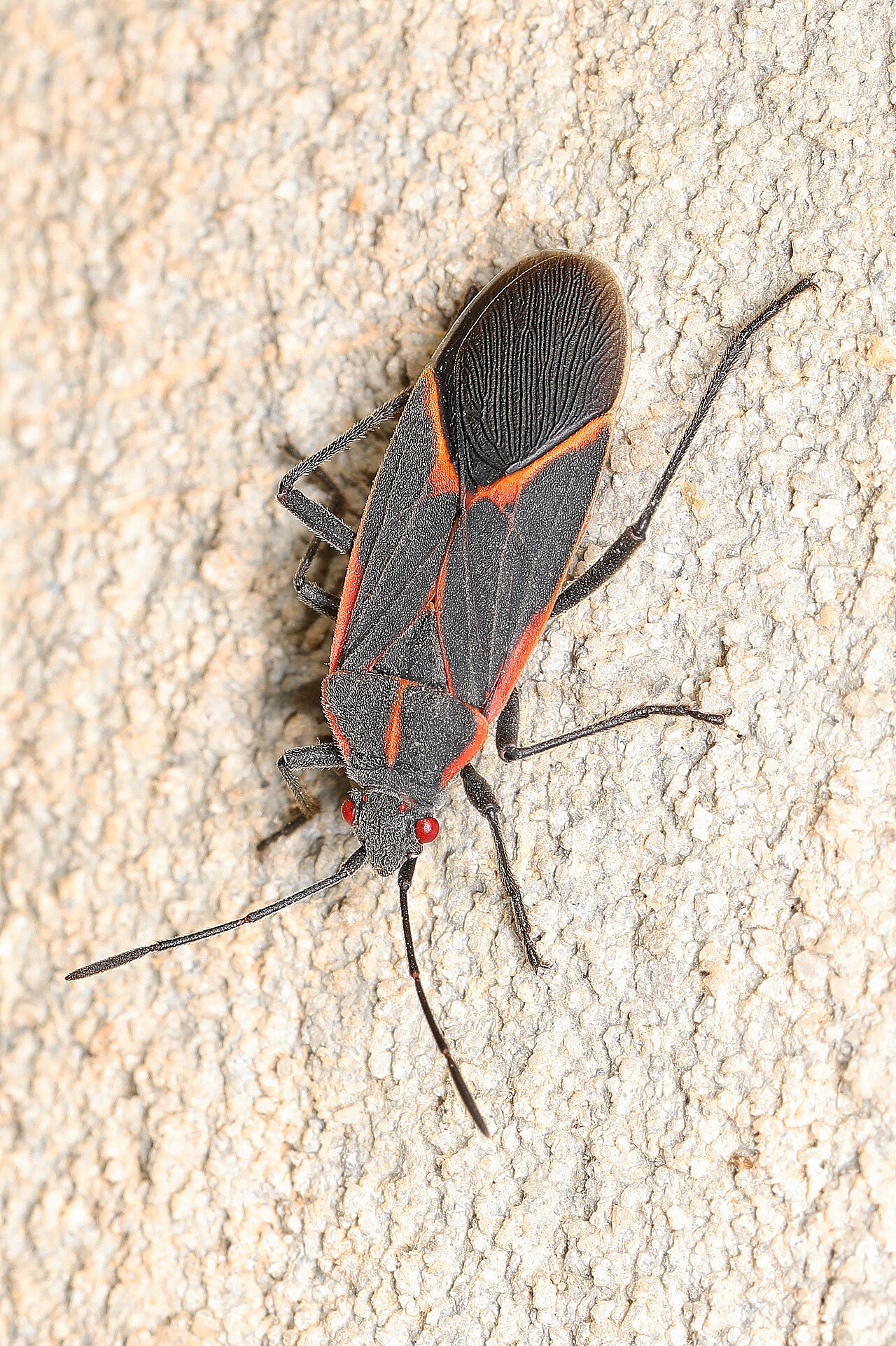
Boxelder bugs are true bugs (the same family as stink bugs and cicadas), and they look the part: adults run about half an inch long, mostly black with red or orange markings — three red lines on the plate behind the head and fine red lines across folded wings. The wing tips overlap in an X when the bug is at rest, and the abdomen underneath is red. Nymphs start out bright red at around a sixteenth of an inch and gain black markings as they grow.
That three-line pattern matters for identification: squash bugs, milkweed bugs and leaffooted bugs get mistaken for boxelder bugs all the time, and the lengthwise red lines on the pronotum are the clean tell. If you are comparing options, the free pest ID wizard walks through body, wings and location.
Boxelder bug look-alikes at a glance
| Bug | The difference | Where you usually see it |
|---|---|---|
| Boxelder bug | Three lengthwise red lines behind the head; red abdomen under black wings | Sunny walls and foundations in fall; boxelder and maple trees in summer |
| Milkweed bug | Similar orange-red and black pattern, but no three-line mark | On milkweed plants — gardens and meadows |
| Squash bug | Dull brownish-black; no bright red at all | Squash and pumpkin vines in vegetable beds |
| Red-shouldered bug | Red-orange and black, shaped like a boxelder bug but slimmer | Seed pods of goldenrain trees; sometimes mistaken for boxelders en masse |
| Leaffooted bug | Distinctive leaf-shaped flare on the hind legs | Fruit and garden plants — a plant feeder, not a home invader |
Why they swarm in fall
Boxelder bugs spend the summer on seed-bearing (female) boxelder trees, feeding on leaves and developing seeds — they rarely bother anything else and cause no meaningful damage to the trees. The crowd you see at the house is generation two: adults that matured in August and September and are now looking for somewhere to spend the winter.
One thing worth knowing before you invest in a campaign: boxelder bugs are not equally bad every year. Populations boom after hot, dry summers followed by warm springs, and vary a lot from neighborhood to neighborhood even in the same season. If this year's swarm is mild, sealing the obvious gaps is often the whole job.
- They come to your walls on purpose. Boxelder bugs are attracted to warm buildings — especially those with large southern or western exposure. Building color does not matter; tall or isolated buildings attract extra attention.
- They travel. Adults can fly several blocks, sometimes farther — so removing the tree in your own yard does not guarantee anything.
- They squeeze into gaps around windows, doors, pipes and foundation cracks, and wait out the winter in wall voids, attics and casings.
- Indoors they are harmless to the house — and doomed. They do not feed, do not reproduce inside, and live only days to a week or so once active. But warm spells wake them up, and that is why you see them all winter and spring.
Are they dangerous? No — but they are messy
Boxelder bugs do not bite, do not sting, and do not damage houses, furniture or food. Their one offense is upkeep: excrement can stain walls, curtains and fabric, and a crushed bug gives off an unpleasant odor. They are a nuisance pest, not a structural one — which is exactly why the fix is physical exclusion first, not a big spraying campaign. For the other small insects that show up on walls in the same season — springtails, booklice, clover mites — the tiny black bugs ID guide separates them in about a minute.
The one-month window: seal before September
Extension guidance is specific about timing — make repairs to entry points before the end of August, ahead of the fall migration. This checklist is the highest-leverage work on the page:
- Screens: repair or replace damaged window and door screens, and the screens on roof and soffit vents, bathroom fans and kitchen fans.
- Utility entries: seal where cables, phone lines, pipes, outdoor faucets and dryer vents pass through the wall — caulk for small gaps, polyurethane expandable foam or copper mesh for larger ones.
- Doors: install door sweeps or thresholds on every exterior door, and a rubber seal along the bottom of garage doors.
- Masonry and stucco: check exterior surfaces for cracks an eighth of an inch or wider and seal them; pay attention to where different materials meet (brick against wood siding) and to roof lines and fascia.
- Weep holes stay open. Brick and stone veneer need their weep holes for ventilation — do not seal them. Ventilation plugs that still allow airflow are the right answer.
- Clear the zone: rake leaves, move rock and board piles, and keep weeds and grass down in a six-to-ten-foot strip around the foundation — especially on the south and west sides. Sweep up boxelder seeds so there is less to feed on.
Removing a female boxelder tree is the single most effective control — it eliminates the food and nursery at the source. Two caveats before you rent a chainsaw: only seed-bearing trees matter, and adult bugs fly well enough that a neighbor's tree can keep the problem going.
When they are already on the wall
Outdoors, in season: clusters on walls and foundations can be knocked back with insecticidal soap or soapy water — repeat as new arrivals show up — or with a labeled exterior insecticide (common active ingredients include bifenthrin, cyfluthrin, deltamethrin, lambda-cyhalothrin and permethrin). Check the product's directions to confirm it is intended for the exterior of buildings. Timing is everything: late summer and early fall, when the first clusters form. Spraying the spring exodus is wasted effort — it has no effect on next fall.
Indoors, any time: vacuum or sweep them up and empty the bag or canister outdoors. Insecticide sprays inside are not recommended — the bugs die on their own within days, and spraying does nothing about the ones still hiding in the walls. Do not crush them where they sit (staining and odor), and do not seal the vacuum bag in the house.
Season-by-season playbook
| Season | What they are doing | What you do |
|---|---|---|
| Spring | Overwintered adults leave buildings and head for trees | Nothing — spraying now does not reduce the fall invasion |
| Summer | Feeding and breeding on female boxelder trees | Sweep up seeds; spot-treat only if trees are heavily loaded |
| Late summer | New adults start moving toward warm buildings | Finish sealing entry points before the end of August |
| Fall | Mass migration; clusters on sunny walls | Treat first clusters (soap or labeled exterior spray); vacuum stragglers inside |
| Winter | Inactive in walls and attics; wake on warm days | Vacuum what emerges; expect it to taper off |
When it is worth calling a pro
Most boxelder seasons need zero professional help. Two exceptions: houses that get invaded every single year despite sealing (a perimeter treatment, correctly timed to the fall migration, is what a pro does well), and tall or multi-story walls where the cluster zones are simply out of reach. Run the numbers first — the DIY vs. pro calculator frames the decision, and the seasonal defense calendar tells you which other pests are active in the same window so one treatment plan covers all of them.
Behavioral and control details on this page follow university extension sources: the University of Minnesota's boxelder bug guide, UC IPM's boxelder bug Pest Notes, and Wisconsin Horticulture's Boisea trivittatus profile.