Why October is the month they arrive
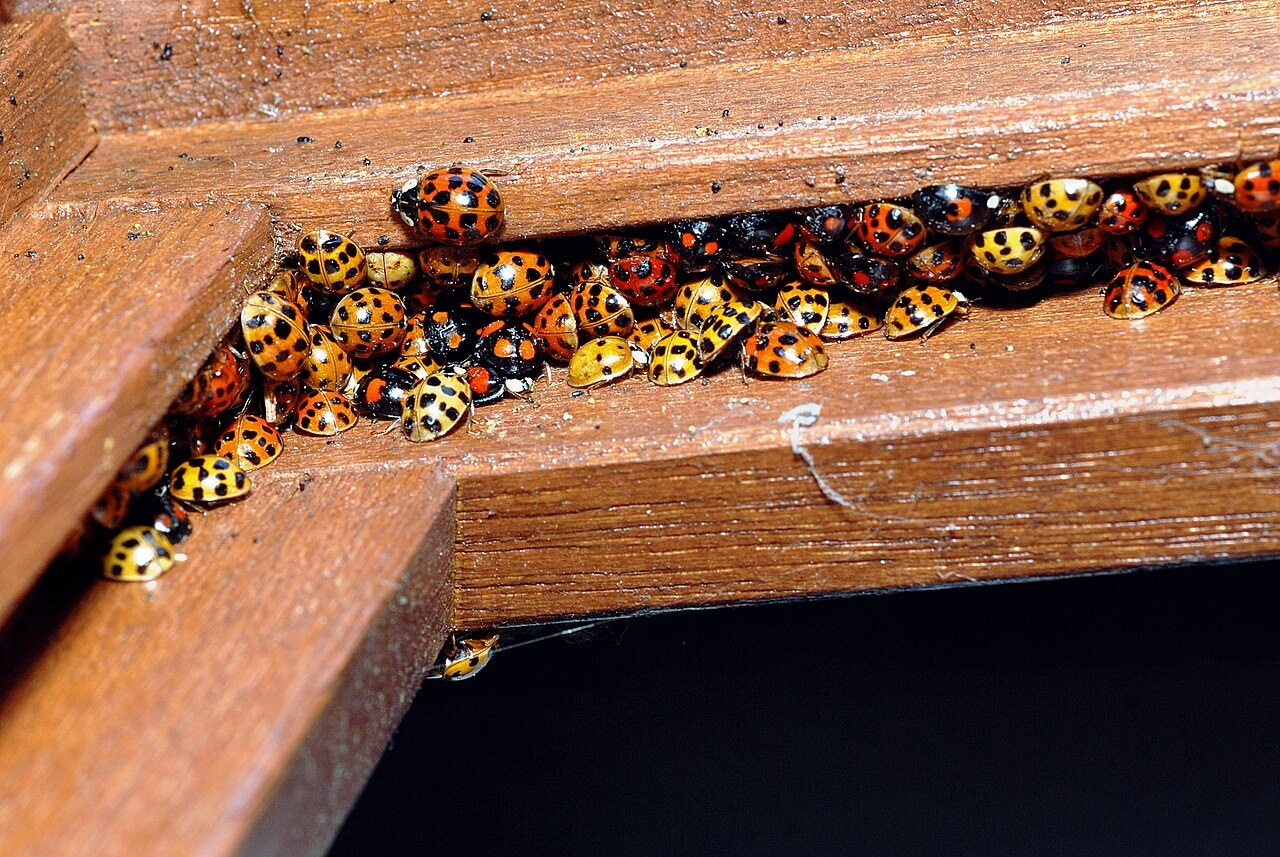
Penn State Extension describes the trigger precisely: on a sunny, warm afternoon that follows a cold night, multicolored Asian lady beetles congregate on the outside of houses, sheds and other buildings in search of somewhere to spend the winter. They are drawn to sunlight reflecting off the south and southwest-facing walls. The same behaviour shows up in their native Japan, where the beetles fly to sun-warmed, south-facing rock cliffs — your siding is simply the local substitute.
Two details explain why an invasion feels so sudden. The first is a chemical: Clemson Extension notes that when a few beetles find a good sheltered spot they release an aggregation pheromone that recruits others to the same location. The second is scale. Penn State states that it is not uncommon for tens of thousands of beetles to gather in attics, ceilings and wall voids. A wall that is quiet on Sunday can be black by Wednesday.
Once inside, they do not settle in for a quiet winter. The beetles move around inside wall voids and emerge into living space as warmth penetrates the walls, and Clemson notes a second wave of sightings on bright, warm days in February and March, when they try to get back outside. That is why a beetle problem on a cold January afternoon usually has an October origin story — and why closing the entry points in September is the only fix that ends it.
Asian lady beetle or native ladybug? The 30-second check
This matters because the two get very different advice. Native lady beetles — the ones you want in a garden — are not the ones piling up on your window trim, and squashing the wrong one costs you a genuine garden ally. The reliable separator is not the spots: Asian lady beetles are famously variable, and their spot count tells you almost nothing.
| Feature | Multicolored Asian lady beetle (Harmonia axyridis) | Typical native lady beetle (e.g. Coccinella spp.) |
|---|---|---|
| The mark behind the head | A white pronotum carrying a black "W" or "M" — the single most useful ID character | Usually two white spots, or a black pronotum edged in white; no W or M shape |
| Size | 9/32 inch (7 mm) long and 7/32 inch (5.5 mm) wide — larger than most native species | Generally smaller, typically around 4–5 mm |
| Colour and spots | Extremely variable: red to orange to yellow, with up to 18 black spots — or as few as four, or none at all; dark forms are black with 2, 4 or 12 red spots | Consistent within the species — the seven-spot really does have seven |
| Where you meet it | In numbers on sunlit south/west exterior walls and window frames in October, then indoors | On plants, in ones and twos, through the growing season |
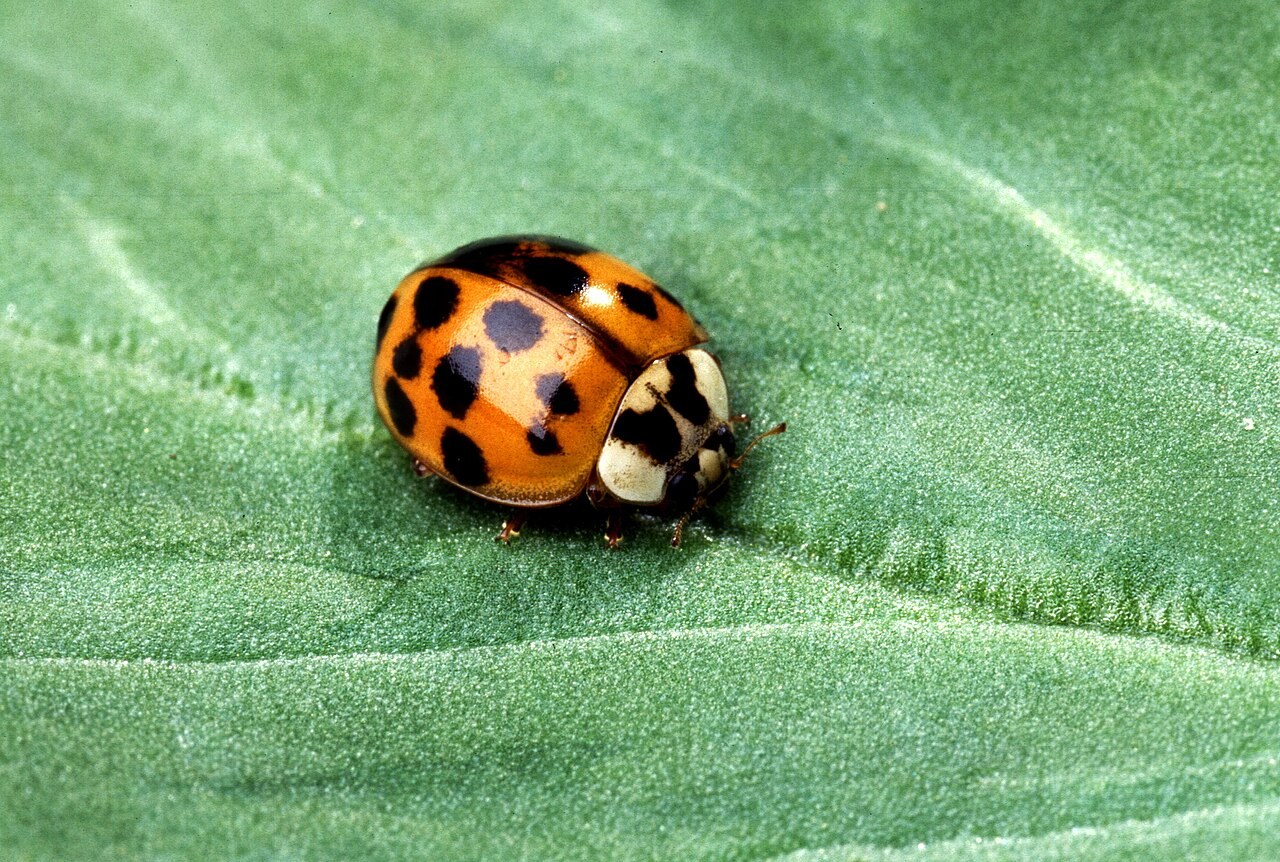
If the beetle in front of you has the W, treat it as the Asian species whatever its colour. If it is a small, uniformly spotted beetle out in the garden, leave it alone. And if what you actually have indoors is a swarm of something much smaller than a lady beetle, the tiny black bugs in the house guide sorts springtails, booklice and carpet beetles — a different problem with a different fix.
The bite, the smell and the stain
Three complaints bring people to this page, and all three have the same underlying cause: the beetle's defensive chemistry.
- The bite. They do bite people, and Penn State notes the sensation varies from slightly annoying to painful. Clemson adds the detail that on tender skin a bite can draw blood. There is no venom and no disease transmission involved — but Penn State also records that blood-fed beetles die at higher rates than ones that did not feed on blood, and that biting correlates poorly with feeding, so the reason they do it is still unresolved. It is not a hunting behaviour.
- The smell and the stain. Disturbed beetles reflex bleed: they ooze a yellow, foul-smelling defensive fluid from their leg joints. This is what spots walls, curtains and upholstery, and why brushing a cluster off a wall is the wrong move.
- The skin reaction. Most people are only annoyed by the smell. A minority get a small, localised welt from the fluid, and Penn State notes that pets which eat the beetles can suffer chemical burns inside the mouth — worth knowing if you have a dog that hoovers up anything that moves.
The allergy picture is the one people underrate. Penn State links lady beetle infestations in homes to rhinoconjunctivitis, asthma and even facial angioedema, and notes that some people cross-react between lady beetles and cockroaches. If indoor beetles coincide with a seasonal flare-up of allergy or asthma symptoms, that is not a coincidence — and it is the strongest argument for excluding them rather than co-existing with them.
What they are not: the reassuring part
Clemson Extension is unusually direct about this, and it is worth reading before you spend money. Multicolored Asian lady beetles do not carry human diseases, do not feed on wood, clothing or food, and do not reproduce indoors. They are not termites, not carpet beetles and not a pantry pest. They cannot start an infestation inside your walls the way a rodent can; they are a nuisance and an allergen, not a structural threat.
They are also genuinely beneficial outdoors. Both larvae and adults are voracious predators of aphids, scale insects and other soft-bodied plant pests, and Penn State notes they are often the dominant lady beetle species in commercial orchard and greenhouse settings. The honest framing is uncomfortable but correct: the beetle on your wall in October has been eating your garden pests all summer, and it is now looking for a place to sleep. The goal is to redirect them, not to exterminate them.
What not to do
| Common move | Why it backfires |
|---|---|
| Brushing or sweeping the cluster off the siding by hand | Disturbing beetles makes them reflex bleed — you trade a wall of beetles for a wall of permanent yellow-brown stains and the smell that goes with it |
| Foggers and "bug bombs" for beetles already on the ceiling | Penn State: they kill the beetles you can see, but do nothing to stop more emerging once the room is aired out — no long-term management, and residues on living surfaces |
| Spraying insecticide into the wall voids once beetles are inside | The documented trap here: killing thousands of beetles in a void leaves a food supply for carpet beetles, which may then move on to woolens, stored dry goods and other animal products. You can convert a nuisance into a fabric-pest problem |
| Crack-and-crevice sprays aimed at where beetles emerge indoors | They do not stop new beetles emerging from other gaps, and they leave pesticide where you live |
| A perimeter spray in September, used alone | Exterior treatment has real but short-lived value — sunlight breaks the residue down, and Penn State describes effectiveness fading within days to a week or two. It is a supplement to sealing, never a replacement |
The fix that works: seal the building, not the beetles
Penn State's verdict is unambiguous — mechanical exclusion is the best method of control for keeping Asian lady beetles out of a building. That means treating the exterior like a rodent-exclusion job, because the openings are much the same list. Seal, with good quality silicone or silicone-latex caulk:
- Cracks around windows and doors, and any gap under exterior door thresholds.
- Openings in siding, and the join line where siding meets trim.
- Wherever utility pipes and lines penetrate the wall.
- Behind chimneys and around the chimney flashing.
- Underneath the wood fascia and along the roofline.
Two jobs need screen rather than caulk: repair or replace damaged door and window screens, and cover attics, fireplace chimneys and exhaust vents with number 20 or smaller screen mesh — that mesh size is the number Penn State gives, and it is the one that actually blocks a 7 mm beetle.
Timing matters as much as the sealant. The work has to be finished before the congregation starts, which in most of the country means a September or early-October weekend. Sealing in November is sealing after the beetles are already in.
If exterior insecticide is being considered for a building that genuinely cannot be sealed — an old house with complex siding, for instance — Penn State's guidance is specific: it should be applied by a licensed pest control operator in late September or early October, just before congregation begins, and it should be understood as a short-lived supplement. That is a professional job, not a homeowner spray-and-hope. The DIY versus pro cost calculator prices both routes, and the pest control contract review lists the recurring-treatment clauses worth questioning before you sign an annual plan.
Getting rid of the ones already inside
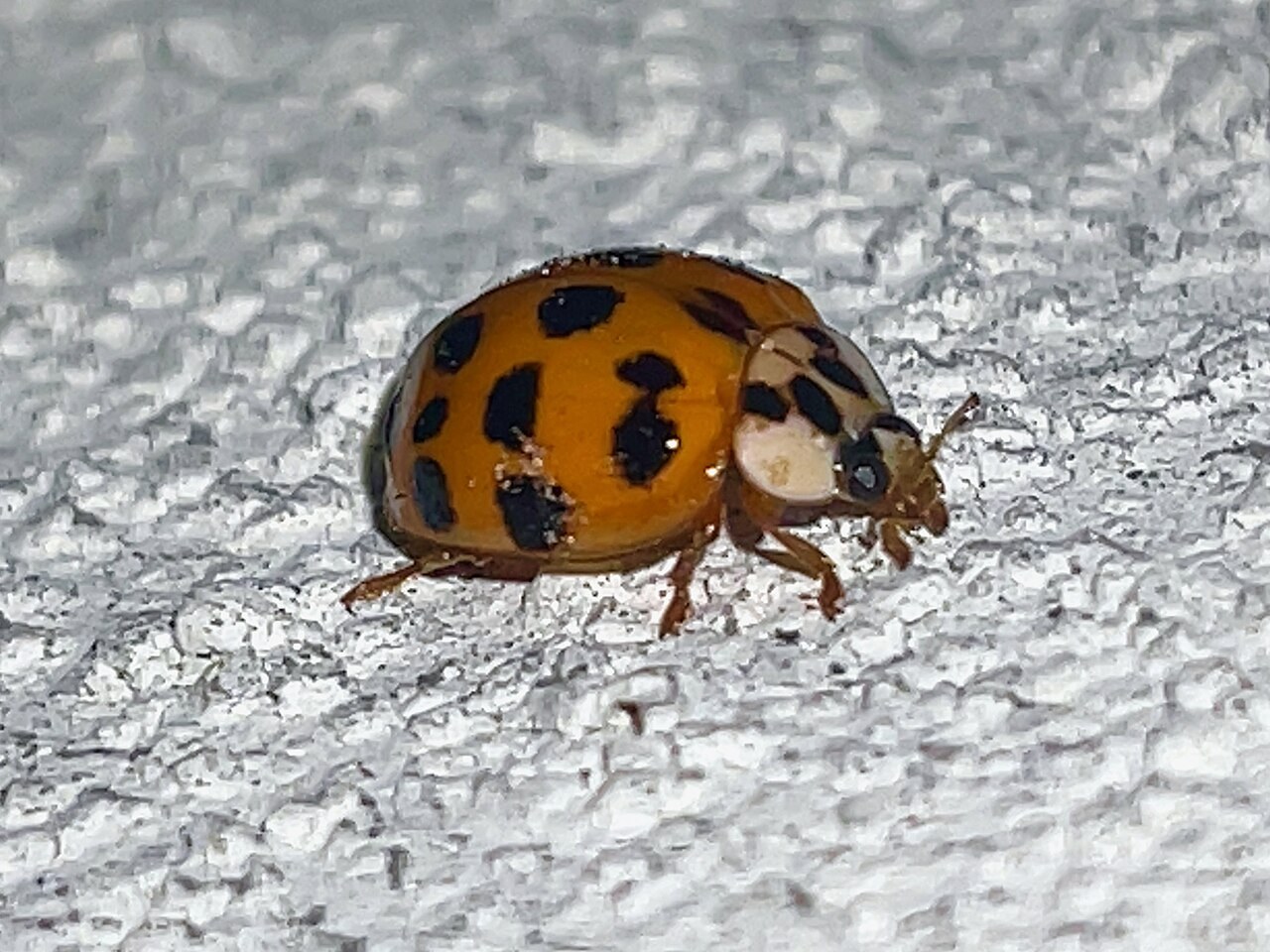
For beetles that have made it in, both extensions converge on the same answer: vacuum them. It removes them without crushing, which means no defensive fluid on your walls. Two versions, depending on your machine:
- Bagged vacuum: remove the bag after each session, then seal it in tape or freeze it before discarding — otherwise the beetles crawl back out of the bag.
- Bagless vacuum: put a nylon stocking inside the hose and secure it with a rubber band; the beetles collect in the stocking, which you tie off and throw away.
One honest caveat comes with the vacuum advice: because the exhaust circulates the beetles' defensive compound into the air, people who are allergic to them may not be able to use this method without symptoms. If that is you, seal the interior gaps first and let the population dwindle rather than agitating a large cluster.
The interior version of exclusion is finding where they are getting out of the walls. Penn State points to cracks under and behind baseboards, around window and door trim, and around exhaust fans and ceiling lights — and to the detail that beetles can see light entering through those cracks, which is exactly what draws them. Tape is a legitimate temporary seal while you work out the rest; start with the rooms where beetles are worst.
Should you buy and release lady beetles?
As a control strategy for an Asian lady beetle invasion, no. Penn State's assessment is blunt: beetles are almost always already present in the surrounding landscape, so if aphid numbers were high enough to justify a release, the local population would already have found them — and because the adults can fly, releasing them when aphid numbers are low just means they disperse. Buying beetles to eat the beetles on your wall is not a thing.
If your interest is in supporting the beneficial insects you already have — and in recognising which of the beetles in your garden are doing useful work — the beneficial bug matchmaker maps the common garden predators to what they actually eat, and the seasonal garden defence planner sequences the season so outdoor work is done at the right time rather than all at once.
Your October action checklist
- Walk the south and southwest walls on the first warm afternoon after a cold night — that is when you will see the congregation starting, and it is your deadline.
- Caulk window and door frames, siding joints, utility penetrations, behind the chimney and under the fascia.
- Screen attic, chimney and exhaust vents with number 20 or finer mesh; replace torn screens.
- Vacuum indoor beetles rather than sweeping or crushing them; bag or freeze the catch.
- Seal the interior gaps they emerge from — baseboards, window trim, ceiling fans and lights.
- Do not fog the attic and do not treat wall voids; both push the problem sideways.
- Note the date and the wall each year. The congregation is remarkably punctual, and next October you will know your own deadline.
Next steps
Asian lady beetles are one of a small group of insects that do the same thing every autumn for the same reason — they are looking for a winter. If you are finding more than one species, the brown marmorated stink bug guide covers the other big October invader, the boxelder bug guide covers the red-and-black species that arrives on the same schedule, and the clover mite guide handles the tiny red specks that are not beetles at all, and the cluster fly guide covers the sluggish grey flies that appear at the windows on the first warm day of winter. Because the entry points are identical, the fall rodent-exclusion guide is a useful companion — seal once, and it works against both.
If you cannot identify what is on the wall in front of you, the pest ID wizard narrows it by size, shape and location, and the IPM pest log keeps a record of what you saw and when, which is the evidence that tells you whether this year's sealing actually worked.
Sources: Penn State Extension, Multicolored Asian Lady Beetle (the sunny-afternoon-after-a-cold-night congregation trigger, south/southwest wall attraction, size and the black "W" on a white pronotum, spot-pattern variation, tens of thousands in voids, cold-weather overwintering, the bite and the rate of blood-feeding, allergy links including asthma and facial angioedema, reflex bleeding and pet mouth burns, the 1916 first release and 1988 establishment, mechanical exclusion and caulk list, number 20 mesh, late-September/early-October exterior treatment and its short residual, the carpet-beetle consequence of void spraying, fogger futility, and vacuuming method); Clemson Cooperative Extension Home & Garden Information Center, fact sheet HGIC 2437, Multicolored Asian Lady Beetles (October–November clustering, the aggregation pheromone, no disease transmission and no indoor reproduction, the bite drawing blood on tender skin, inhalant allergies and contact dermatitis, the 1977–1981 USDA release programme and the 1988 Louisiana recovery, and vacuuming as the preferred removal method); Ohio State University Extension, Ohioline fact sheet ENT-44, Multicolored Asian Lady Beetle (the USDA release programme being halted on failure to recapture, establishment reported from the early 1990s, the October 1993 Ohio recognition, and population decline and rebound since the mid-2000s); University of Minnesota Extension, Multicolored Asian lady beetles (the black M-shaped marking behind the head as the field ID character, fall clustering around buildings, and the principle of using control measures only to keep them from getting indoors).