The 30-second answer
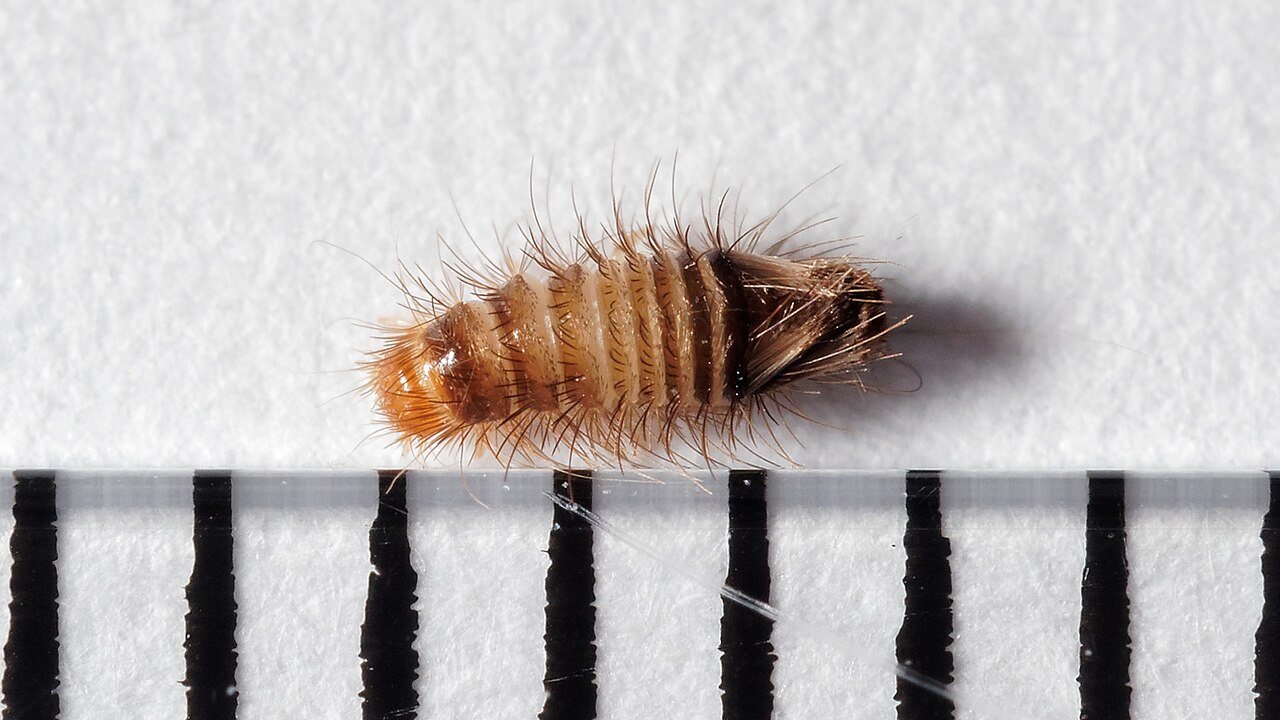
- If it has visible bristles, hairs or a tail brush, and it is crawling on fabric during the day, it is a carpet beetle larva. Larvae reach roughly 4–13 mm depending on species and are covered in hairs — UC IPM describes them as looking like "fuzzy or hairy maggots."
- If it bit you, no bristly insect did it. Carpet beetle larvae have chewing mouthparts for wool, fur and dead insects — not skin. The 2021 case series in Emerging Infectious Diseases that documented carpet beetle skin reactions is explicit that the lesions "mimic bites but are allergic reactions to larvae hairs pegged in the skin" and "should be distinguished from bites of bed bugs or fleas" (Simon et al., Emerg Infect Dis 2021;27(7):1940–1943, doi:10.3201/eid2707.203245).
- Bed bugs are smooth, flat and oval — not hairy. Adults run about 5 mm (1/5 inch), are rusty red or mahogany, and have no bristles to speak of (UC IPM Pest Notes 7454).
What you are actually looking at
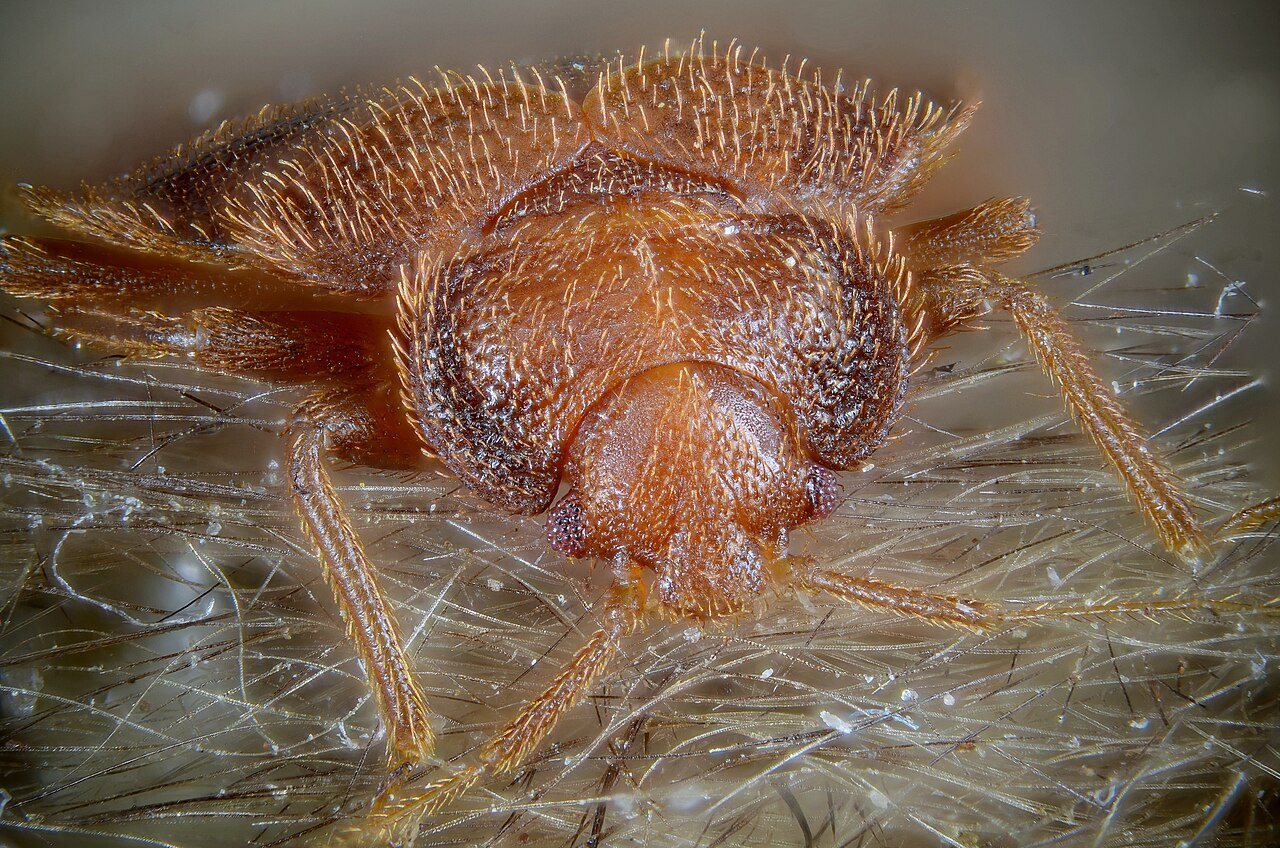
Look at the outline before anything else. A bed bug is a smooth, glossy, flattened oval that slides into a mattress seam like a coin into a slot. A carpet beetle larva is a segmented, carrot- or cigar-shaped body wearing a dense coat of hairs, and several species end in a long tail brush of bristles. If the insect in front of you looks "furry," you are not looking at a bed bug.
Side-by-side comparison
| Trait | Carpet beetle larva | Bed bug (adult / nymph) |
|---|---|---|
| Body surface | Dense hairs or bristles; black carpet beetle larvae are shiny with short stiff hairs and a tail tuft | Smooth, glossy, no visible bristles |
| Shape | Carrot- or cigar-shaped; varied carpet beetle larvae are broader at the rear, furniture carpet beetle larvae broader at the front | Flattened oval, roughly apple-seed shaped |
| Typical size | About 1/5 inch (Anthrenus spp.) up to 1/2 inch (black carpet beetle) | Adults ~1/5 inch; nymphs from 1/20 inch, pale yellowish-white |
| Where you find it | Carpet edges, under baseboards, air ducts, closets, under heavy furniture, stored woolens and cereals | Mattress seams, box springs, bed frames, headboards, cracks within a few feet of where people sleep |
| What it eats | Wool, silk, fur, feathers, hair, felt, leather, dead insects, pet food, stored grain | Blood only |
| Does it bite people? | No. Bristles can cause an itchy rash in sensitive people, which is often misread as bites | Yes — painless bites, usually noticed 1 to several days later |
| Signs it leaves | Cast larval skins (often more numerous than the larvae), salt-grain-sized fecal pellets, holes in fabric with no webbing | Shed exoskeletons, dark fecal spots, rusty blood spots on bedding, sweet musty odour |
| Movement | Slow crawl on fabric in daylight; larvae avoid light and hide in dark, undisturbed spots | Fast crawl; hides by day in cracks and crevices |
The life-stage trap: adults and larvae look nothing alike
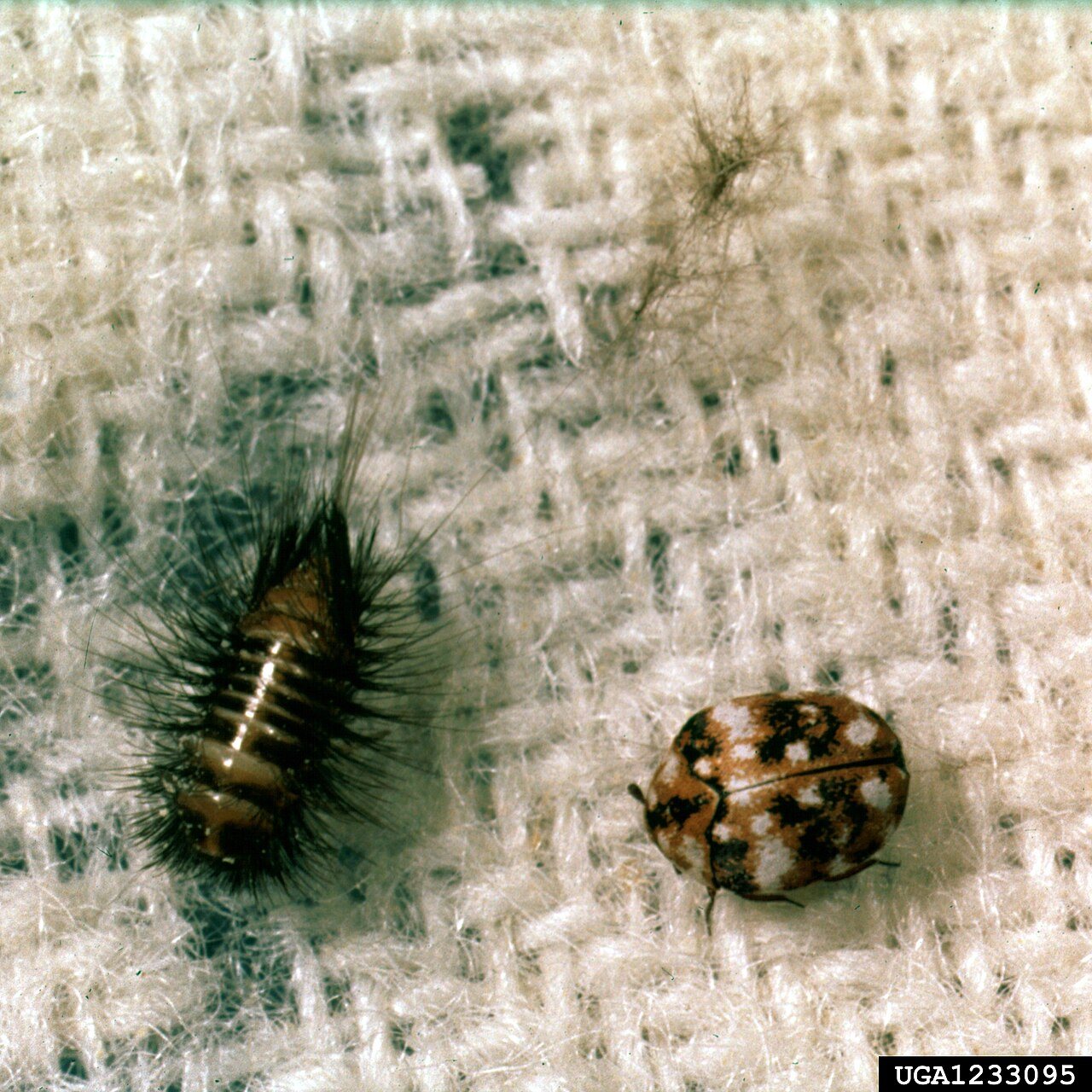
Carpet beetles fool people twice. The larvae are the hairy crawlers that damage fabric; the adults are small, round, mottled beetles that look a little like miniature lady beetles and are usually spotted dead on a windowsill or crawling on a wall in spring and early summer. Adults do not feed on fabric at all — they are pollen feeders that fly in from flowers, through open windows, or hitchhike indoors on cut flowers (UC IPM Pest Notes 7436).
That is why the size of the thing you are looking at matters. An adult carpet beetle is only about 2–3 mm (1/12 to 1/8 inch) for the Anthrenus species, while a mature larva of the same beetle is roughly 5 mm and a black carpet beetle larva can reach 13 mm — noticeably longer than an adult bed bug. Rutgers Extension's fact sheet on carpet beetles notes the head-narrower-than-tail shape of varied carpet beetle larvae, which is a useful tiebreaker when two larvae look alike (Rutgers NJAES FS1181).
Reproduction, in numbers
Neither insect is a one-off sighting. UC IPM publishes the per-species life cycle for carpet beetles, and the totals explain why an infestation lingers:
| Species | Eggs laid | Eggs hatch | Larval stage |
|---|---|---|---|
| Varied carpet beetle (Anthrenus verbasci) | 40 | 10–20 days | 220–630 days |
| Furniture carpet beetle (Anthrenus flavipes) | 60 | 9–16 days | 70–94 days |
| Black carpet beetle (Attagenus unicolor) | 90 | 9–16 days | 166–330 days |
Bed bugs run on a different schedule entirely. A female lays 200–500 eggs over her life, two to five a day, hatching in about 10–15 days at room temperature; the full egg-to-adult cycle takes five weeks to four months, fastest between 70°F and 82°F. A bed bug can also outlast a vacant treatment window — 20 to 400 days without a blood meal, and adults have survived over 400 days in the laboratory. That is the detail behind the bed bug lifespan guide.
Why the confusion matters (the treatments share nothing)
Carpet beetle control is sanitation plus exclusion. Bed bug control is professional inspection and treatment. Applying one plan to the other problem is the single most common way homeowners waste a season and several hundred dollars.
If it is carpet beetles: remove the food, then the larvae
- Find the source before treating anything. Work with a flashlight along carpet edges, under baseboards and heavy furniture, in closets, in air ducts and in stored woolens, furs and cereals. Extension guidance: identify the exact spot where larvae are feeding, and note that cast skins are often more abundant than the larvae themselves.
- Vacuum aggressively and empty the bag outside immediately. Lint, hair and dead insects are the food base; Rutgers specifically warns to discard the vacuum bag right after use so nothing crawls back out.
- Wash or dry-clean infested textiles. Hot laundering or dry cleaning kills all stages. For items that cannot be washed, bag them and freeze at household freezer temperature for two weeks, then let them return to room temperature inside the sealed bag to avoid condensation damage.
- Store clean woolens sealed. Airtight containers and bags are the reliable protection. Cedar chests are not: Rutgers reports the volatile cedar oil is not an effective repellent and is gone after about 36 months.
- Skip the foggers. Aerosol "bug bombs" have poor penetration and are documented as ineffective for carpet beetles — both Rutgers and Ohioline say so, because the larvae sit in cracks and crevices the fog never reaches.
- Spot-treat, and only where the label allows. If sanitation is not enough, insecticides labelled for carpet beetles can be applied as spot treatments along floor covering edges, under rugs and furniture and in cracks — never on clothing or bedding. Severe cases are professional work; most householder products once sold for carpet beetles have been withdrawn (Ohioline HYG-2103).
If it is bed bugs: confirm, then escalate
- Inspect, don't guess. Use a flashlight on mattress seams, box springs, bed frames and headboards. Look for live bugs, shed skins, dark fecal spots and rusty blood spots.
- Non-chemical first moves work for small numbers. Vacuum seams and baseboards, wash bedding and clothing in hot water around 120°F and dry on the hottest setting, and fit mattress encasements so any remaining bugs are sealed in and eventually die.
- Do not reach for a fogger. UC IPM is blunt about it: consumer aerosol foggers are not effective for bed bug control and can be harmful to your health.
- Bring in a professional for a real infestation — and price it before you commit. The bed bug cost calculator and the heat treatment cost guide cover the ranges; the DIY vs pro calculator shows where doing it yourself stops making financial sense.
- If you rent, tell your landlord. Bed bug work in multi-unit buildings almost always involves more than one unit.
What to do this week
Whichever insect it turns out to be, the first hour of work is the same: catch one, look at its surface and outline, and note where you found it. A hairy, carrot-shaped crawler on a wool blanket is a fabric problem with a mopping-up plan. A smooth oval pulled out of a mattress seam is a blood-feeding problem that needs a licensed professional. When you are stuck between the two — or between either of them and the small dark specks covered in the tiny black bugs ID guide — run the specimen through the pest ID wizard before spending money.
- Seal first, spray later. Door sweeps, screens and tight storage stop the next generation of carpet beetles from arriving; they do nothing for bed bugs already inside.
- Log the sighting. Date, room, surface, and a photo. Repeated sightings in one room is how you tell a settled infestation from a stray insect — use the IPM pest log.
- Check any insecticide against pets before it goes down. Permethrin, a standard treatment ingredient, is severely toxic to cats even in tiny amounts — the pet safety checker covers the common actives.
- Read bite patterns critically. If the marks appear in lines or clusters on skin exposed while sleeping, work through the bed bug bites vs mosquito bites comparison rather than assuming; skin reactions to carpet beetle hairs are a documented mimic (Simon et al., Emerg Infect Dis 2021;27(7):1940–1943).
Sources for this page: UC IPM Pest Notes 7436 (Carpet Beetles) and 7454 (Bed Bugs), Ohioline HYG-2103 (Carpet Beetles, Ohio State University Extension), Rutgers NJAES FS1181 (Carpet Beetles), CDC — About Bed Bugs, and Simon L. et al., "Anthrenus sp. and an Uncommon Cluster of Dermatitis," Emerging Infectious Diseases 27(7):1940–1943, 2021.