Carpet beetles in 30 seconds
Four species cause almost all household carpet beetle damage in the United States, and they behave the same way. Understanding the two stages is the whole game:
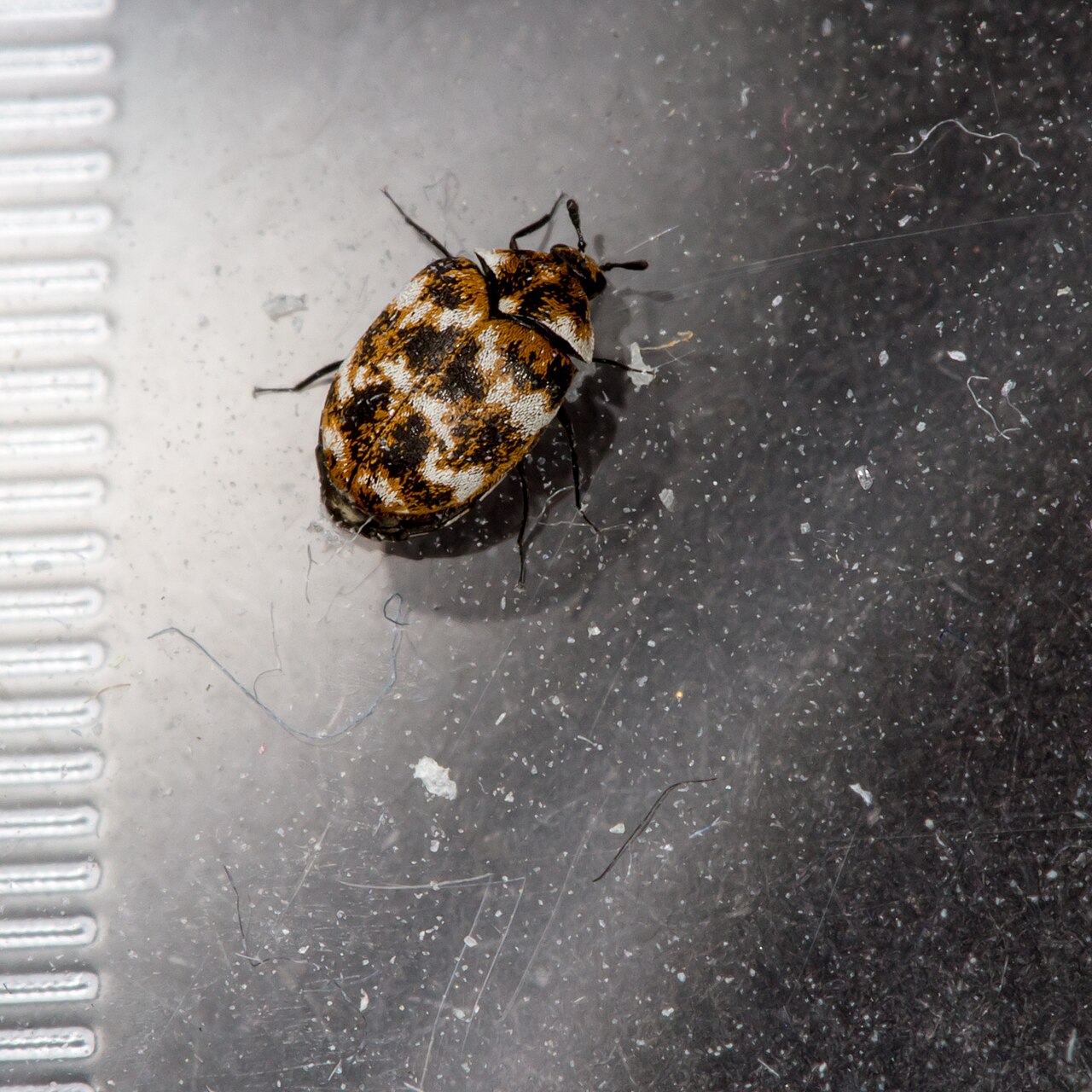
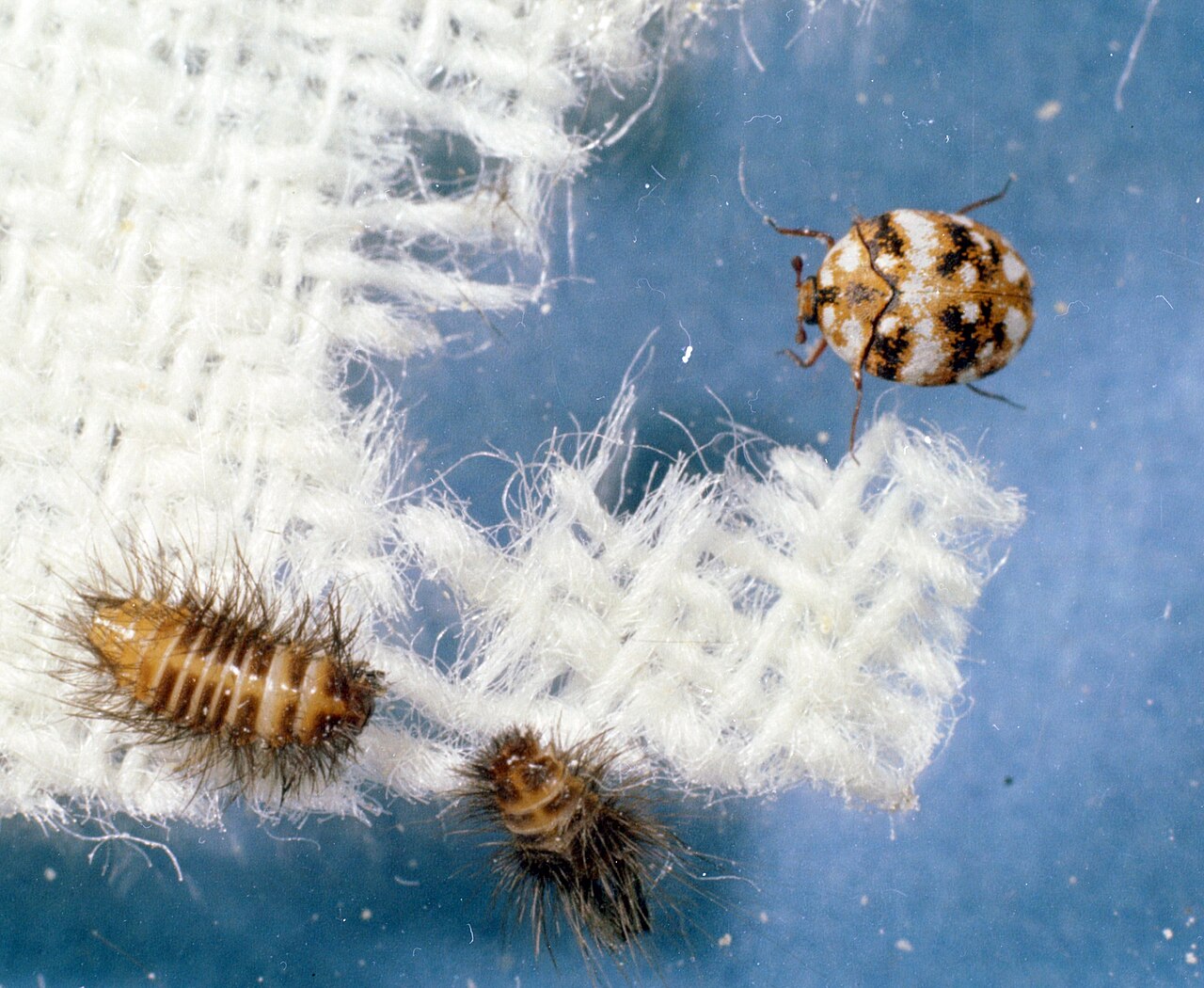
- The adult is a small, oval beetle, usually mottled or plain black. It lives outdoors on flowers, flies in through open windows and doors, and turns up on windowsills because it is attracted to light. It does not eat fabric.
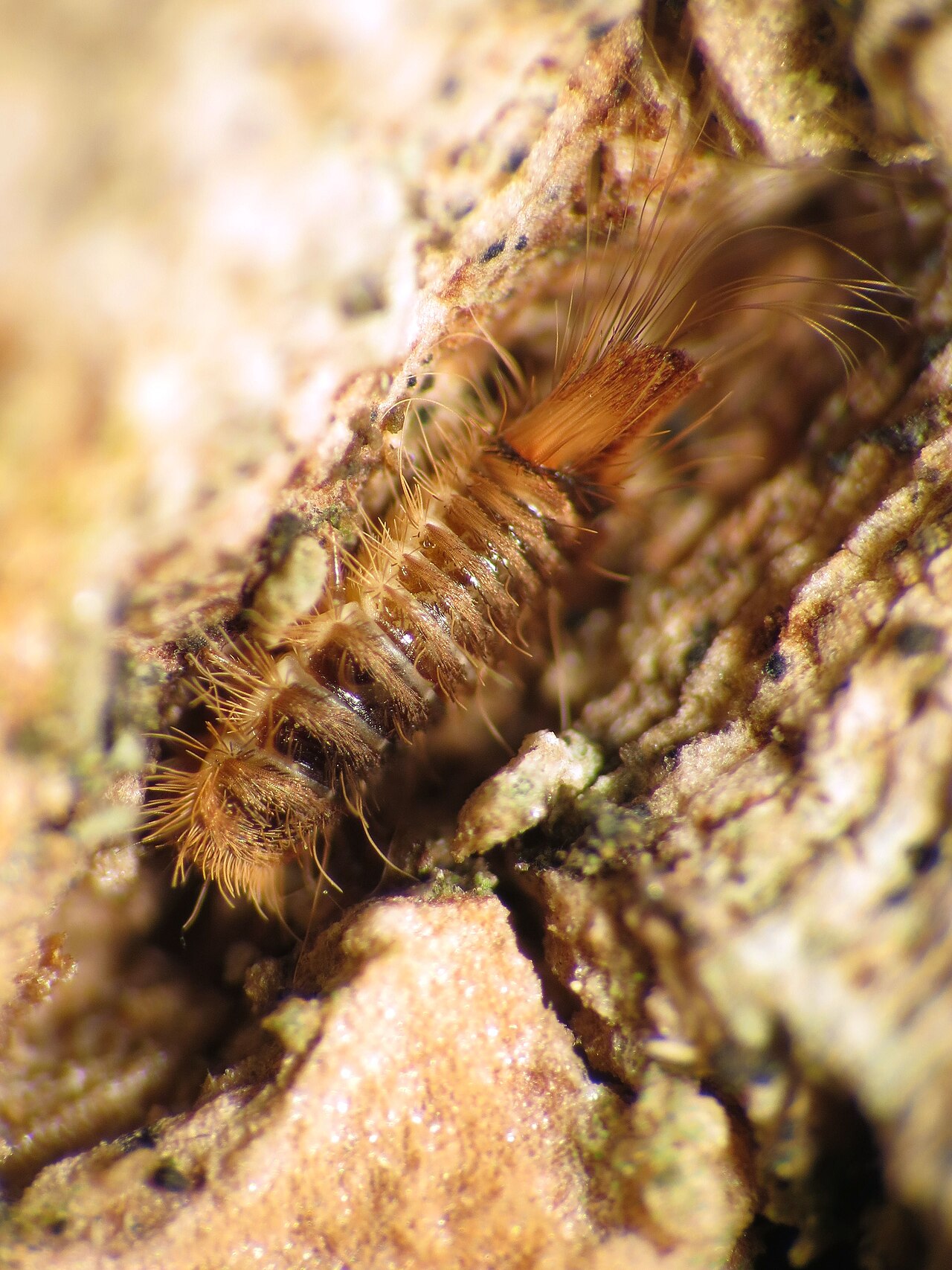
- The larva is the destructive stage: a slow-moving, densely bristled grub that avoids light and feeds on animal-based fibres. It sheds its skin as it grows, so cast skins are usually easier to find than the larvae themselves.
So beetles at a window are the adults — a location clue, not the infestation. Killing them changes nothing. The infestation is wherever larvae are feeding, and that is almost always a dark, undisturbed place you have not cleaned in a while.
Which carpet beetle is it?
Ohio State's extension fact sheet separates the four common species by adult size and scale pattern and by larval shape. A hand lens helps, but size and larval shape will usually get you there.
| Species | Adult | Larva |
|---|---|---|
| Black carpet beetle (Attagenus unicolor) | Oval and shiny black with brownish legs, 1/8 to 3/16 inch | Golden to dark brown, about 1/2 inch, shaped like an elongated carrot or cigar with a long brush of bristles at the tail |
| Varied carpet beetle (Anthrenus verbasci) | Nearly round, about 1/10 to 1/8 inch, grey with a mixture of white, brown and yellow scales and irregular black crossbands | About 1/4 inch, light to dark brown, wide-bodied and distinctly broader at the rear than the front |
| Common carpet beetle (Anthrenus scrophulariae) | Nearly round, 1/10 to 1/8 inch, grey to black, with a band of orange-red scales down the middle of the back and around the eyes | Elongated and oval, reddish-brown, about 1/4 inch, covered with many brownish-black hairs and often moving quickly |
| Furniture carpet beetle (Anthrenus flavipes) | Nearly round, 1/16 to 1/8 inch, whitish and checkered with black spots outlined in yellowish-orange scales; the underside is white | About 1/4 inch, elongated and oval, thickly covered with brownish hair, also often moving quickly |
Two are worth knowing by name. The black carpet beetle is the most common species in the United States and the one most likely to be found in stored food as well as fabric. The varied carpet beetle is the classic windowsill beetle of late spring and early summer.
The life cycle, and why it explains the timeline
Carpet beetles pass through egg, larva, pupa and adult stages, and the larval stage is unusually long. UC IPM publishes the timing side by side for the three species it treats as serious fabric pests:
| Characteristic | Varied carpet beetle | Furniture carpet beetle | Black carpet beetle |
|---|---|---|---|
| Number of eggs laid | 40 | 60 | 90 |
| Days before eggs hatch | 10 to 20 | 9 to 16 | 6 to 16 |
| Days in the larval stage | 220 to 630 | 70 to 94 | 166 to 330 |
| Days for pupation | 10 to 13 | 14 to 17 | 8 to 14 |
| Weeks as an adult | 2 to 6 (female); 2 to 4 (male) | 4 to 8 | 4 to 8 |
Read the third row again. A varied carpet beetle can spend 220 to 630 days as a feeding larva, and Ohio State notes a full life cycle can take two to three years in some species. That is why a single summer of beetles becomes a problem two years later. Eggs hatch in about two weeks at typical indoor temperatures of 25 to 26 degrees Celsius, and warm indoor rooms shorten the cycle compared with an unheated part of the house — a heated closet is a faster factory than a cold attic.
What carpet beetles actually eat
UKY's explanation is keratin, the fibrous animal protein in wool, fur, felt, silk, feathers, skins and leather, which the larvae are able to digest. Ohio State's list adds the practical details: wool, fur, feathers, hair, hides, horns, silk, velvet, felts and bone, plus seeds, grain, cereals, cake mixes, rye meal and flour, and powdered milk, dog and cat food, leather, book bindings and dead insects. Cotton, linen, rayon and jute are attacked too, but — Ohio State again — especially when stained with spilled food or animal excreta.
The headline is that the crumbs and pet hair you have not vacuumed are food. Rutgers lists lint around baseboards and carpet edges, hot-air furnace ducts and mouse carcasses among the places females lay eggs.
Carpet beetle damage or clothes moth damage?
It is not always possible to tell from the damage alone, but the pattern usually settles it and the debris left behind settles it completely.
| What you see | Carpet beetles | Clothes moths |
|---|---|---|
| Shape of the damage | Usually a large area on one portion of a garment or carpet | More often scattered holes |
| What is left in the fabric | Brown, shell-like, bristly cast skins — and no webbing | Silken webbing, tubes or cases spun by the larvae |
| The larvae themselves | Slow-moving, densely haired, tan to brownish, 1/8 to 1/4 inch, carrot or tear-drop shaped | Creamy-white caterpillars, often inside a silken tube or a fibre case they carry |
| Diet range | Animal fibres plus seeds, cereals, pet food and other plant material | Animal fibres only |
Pale, bristly skins in a jumper with no webbing and one big threadbare patch means carpet beetles almost every time. Run the same check against carpet beetle larvae versus bed bugs before treating a bedroom — the two are mixed up constantly and the treatments share nothing.
Where to look first
- Stored wool and fur. UKY's examples: a seldom-used wool or fur hat or scarf on a closet shelf, or an antique rug in the basement. Check seams, folds, cuffs and collars, where larvae prefer to feed.
- The edges of rugs and carpets. Larvae tend to infest the lower edges; UKY suggests lifting the outer edge of wall-to-wall carpet from the tack strip along the baseboards with needle-nose pliers.
- Baseboards, floor vents and air ducts. Pet hair and lint accumulate here, and UKY and Ohio State both name air ducts and heating-system ducts as breeding sites.
- Under and inside upholstered furniture, and piano felt. Ohio State notes feeding damage under heavy furniture and pianos, and that infested piano felt can be damaged badly enough to affect the instrument's tone and action.
- Attics, chimneys, basements and light fittings. Larvae can develop on abandoned bird and wasp nests, on dead insects such as cluster flies, lady beetles and stink bugs, and on dead birds or rodents in wall voids. If there is no wool anywhere near your worms, read white worms in the house for that case.
- The kitchen and garage. Cereal, flour, pet food, bird seed and rodent caches bring carpet beetles into stored products; the pantry moth checklist walks that inspection through shelf by shelf.
How to get rid of carpet beetles
Control is sanitation plus exclusion. UC IPM's position is blunt: if exclusion and sanitation succeed, insecticide treatments are not required. Work in this order.
- Find and remove the source. Infested items and susceptible articles nearby should be laundered, dry-cleaned or discarded, and bagging heavily infested items before disposal stops the beetles spreading on the way out. Remove abandoned bird and insect nests from attics and under eaves.
- Dry-clean, hot-wash or freeze. Dry-cleaning or hot laundering kills any eggs or larvae present, and UKY notes the heat of a clothes dryer is effective as well. UC IPM's wording is the same: wash infested items in hot water or dry-clean them to kill all stages.
- Vacuum like it is the treatment. Vacuum floors, carpets and inside heating vents to remove larvae along with the hair and lint that would support the next generation — along and beneath carpet edges, along baseboards and under furniture. UMD adds the detail people miss: put the vacuum cleaner bag out with the rubbish.
- Stop the adults coming in. Check window screens, doors and vents for gaps, watch windowsills for beetles since they are drawn to light, and inspect cut flowers before bringing them inside — adults arrive on cut flowers and fly in on warm spring days.
- Store clean and sealed. Clean wool before it goes into storage, because soiled fabric and perspiration residues are what attract carpet beetles, then seal it in tight-fitting plastic bags or containers. Closing off the other nesting sites helps too: keeping mice out removes a favourite carpet beetle nursery at the same time.
Do you need an insecticide?
Usually not, and the labels have narrowed. Ohio State notes there used to be many insecticides labelled for carpet beetle control that were available to homeowners, but most have been removed from the market because of toxic residues, and that if sanitation, prevention and paradichlorobenzene treatments do not control the infestation, the next step is a pest control professional.
Where a product is used, the sources are specific about placement. For items that cannot be washed, spot-treat with an insecticide labelled for carpet beetles. Do not spray clothing or bedding. Inspect carpets and spray both sides if live larvae are found. Treat attics, wall voids and other inaccessible places with an insecticidal dust labelled for carpet beetles, taking precautions against inhaling it. For serious infestations UC IPM also recommends sticky traps, and in commercial storage a monitoring programme using pheromone-baited traps.
What does not work
Four remedies come up repeatedly in search results and are contradicted by the extension literature.
| The remedy | Why it fails |
|---|---|
| Cedar chests and cedar-lined closets | UKY: seldom effective, because the seal is insufficient to hold lethal or repellent concentrations of the cedar oil. UC IPM: not reliable or effective, and the oil dissipates over time. Ohio State: helps, but not 100 percent effective |
| Bug bombs (total-release aerosols) | Ohio State: generally not effective at reaching the tiny cracks and crevices where the larvae live |
| Scattering mothballs loosely around a closet | UKY: naphthalene and paradichlorobenzene vapours only deter fabric pests at sufficient concentration, achieved by sealing the item in a bag or box with the labelled dose — and they are hazardous if used incorrectly, so never leave them where children or pets can reach them |
| Spraying the beetles you can see | The adults on a windowsill do not eat fabric. The damage is done by larvae in dark, concealed places, so surface spraying misses the insects that matter and does nothing for eggs and larvae inside a stored jumper |
Carpet beetles in stored food
In California and other arid areas the black carpet beetle is a more serious pest of stored products — grains, flours and cereals — than it is a fabric pest. Unlike clothes moths, some carpet beetles also infest seeds, cereals, pet food and other plant-based materials.
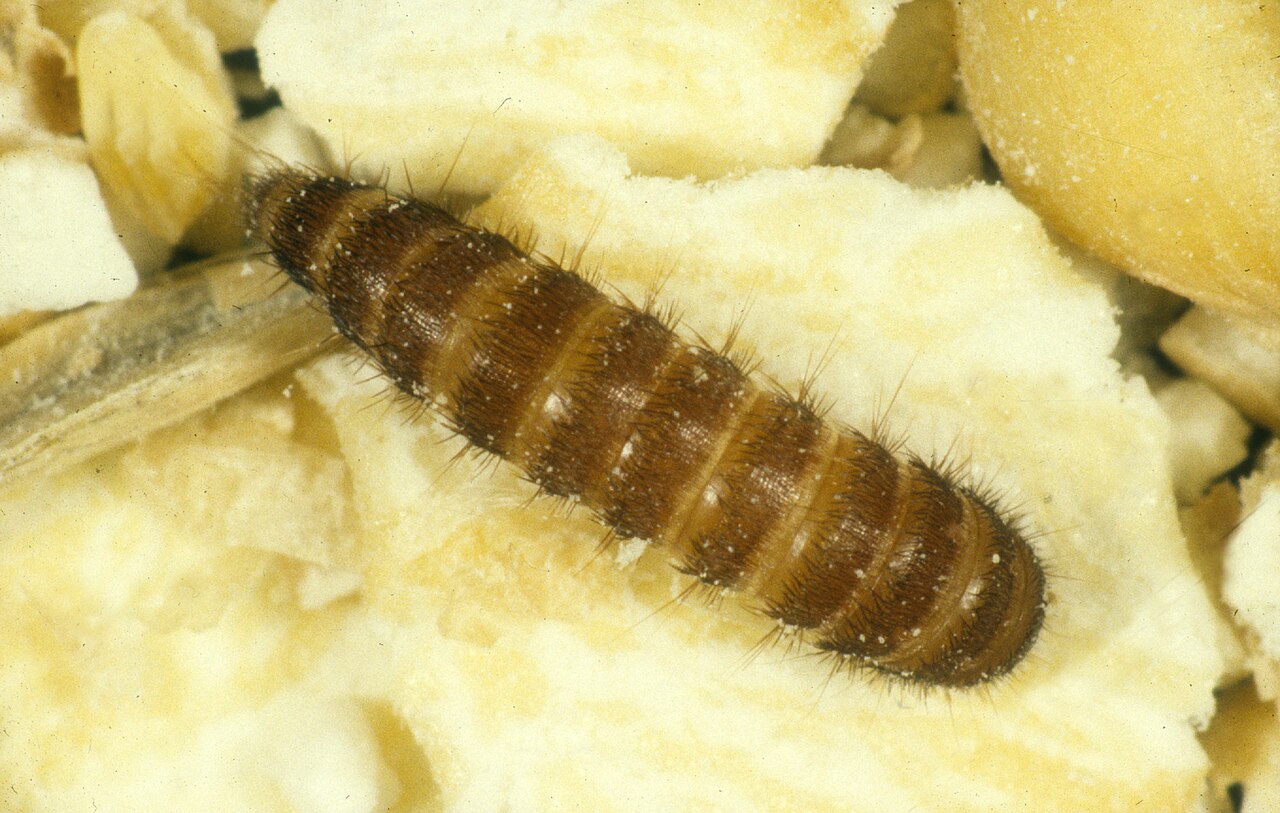
So a kitchen find is not automatically a pantry moth problem. If the larvae are bristly rather than caterpillar-like and there is no webbing, treat it as carpet beetles and extend the inspection to the pet food bin, the bird seed and anywhere rodents have cached food.
When to call a professional
- You cannot find the source after a thorough inspection and the infestation keeps producing adults.
- The source is a wall void or another inaccessible space, such as a dead bird or rodent.
- You have valuable furs, taxidermy or collections. Ohio State notes fur storage in cold vaults is effective, and that infested collections need specialist care.
- Sanitation and prevention have not worked. Ohio State's advice is then to seek a pest control professional, whose toolkit includes products and, in severe cases, fumigation techniques that are not available over the counter.
Before you sign anything, run the DIY versus professional calculator to put a number on repeating service, and the contract review tool to check what the agreement commits you to. If animals or birds share your home, the pet safety checker is worth two minutes before any treatment, and the IPM pest log keeps the inspection record that stops the same corner being re-infested next year.
A short annual routine that keeps them out
- Vent the stored wool. Inspect stored woolens, linens and furs, and air them in the sun once a year.
- Clean before you store. Wash or dry-clean, then seal in a tight container: soiled wool is particularly attractive to carpet beetles.
- Keep the vacuum going along the edges. Baseboards, carpet edges, under furniture and inside vents — the places larvae hide and lint accumulates.
- Clear the dead-insect supply. Old spider webs and accumulations of dead insects around light fittings, window frames and attics are larval food.
- Fix the seal on the building. Screens, vents, doors and windows with gaps let adults in every spring; sealing cracks around a seldom-opened closet's doors, walls and ceiling turns it into genuine pest-free storage. Outdoor work is worth keeping conservative — beneficial bug matchmaker separates the insects worth protecting from the ones that are not.
None of it is dramatic, which is the point. Carpet beetles are one of the few household pests where the boring answer — vacuum, wash, seal — is also the one that works, and a two-year larval stage means you will not know it worked until next season.
Sources: University of California Statewide IPM Program, Pest Notes, Carpet Beetles (adults 1/8 to 1/10 inch and larvae like fuzzy, hairy maggots; the three serious fabric species; eggs hatching in about two weeks at 25 to 26 degrees Celsius; the life-cycle table of 40/60/90 eggs, 10-20/9-16/6-16 days to hatch, 220-630/70-94/166-330 larval days, 10-13/14-17/8-14 pupal days and 2-6/4-8/4-8 weeks as an adult; cast skins and salt-grain-sized faecal pellets as the evidence of feeding; large-area versus scattered-hole damage; cedar chests being unreliable; the black carpet beetle as a stored-product pest in arid areas; the adult pollen diet and the cut-flower and open-window entry routes; the exclusion and sanitation checklist; spot-treating un-washable items, never spraying clothing or bedding, and insecticidal dusts in attics and wall voids; and pheromone-baited sticky-trap monitoring); Rutgers NJAES Cooperative Extension Fact Sheet FS1181, Carpet Beetles (carpet beetles damaging carpets, rugs and woolens more than clothes moths; the black carpet beetle as the most common species at 1/8 to 3/16 inch with a carrot-shaped larva up to 1/2 inch with a tail of long hairs; the varied carpet beetle larva's narrower head end; the larval diet; 40 to 90 eggs hatching in one to two weeks; the larva moulting 8 to 17 times; a larval stage of 70 days to more than a year; adults emerging after about two weeks; and eggs laid on lint around baseboards, carpet edges and hot-air furnace ducts); University of Kentucky Department of Entomology, ENTFACT-601, Carpet Beetles (keratin as the reason wool, fur, felt, silk, feathers, skins and leather are attacked, and the cotton/synthetic exception; adults 1/16 to 1/8 inch; 50 to 100 eggs; larvae 1/8 to 1/4 inch, tan to brownish, slow moving and densely covered with hairs or bristles; threadbare spots and irregular holes; feeding within fabric folds in closets, chests and boxes while items in regular use are seldom attacked; larvae along the lower edges of rugs and the needle-nose-pliers check at the tack strip; pet hair and lint around baseboards, air vents and ducts; bird nests, animal carcasses and dead insects in attics, chimneys, basements and light fittings; seeds, cereals, pet food and rodent caches; laundering, dry-cleaning and bagging before disposal; vacuuming floors, carpets and heating vents; sealing clean items with the labelled dose of naphthalene or paradichlorobenzene and its concentration requirement; and cedar closets and chests being seldom effective because the seal is insufficient); The Ohio State University Extension, Ohioline HYG-2103, Carpet Beetles (the four-species adult and larval descriptions and sizes; larvae crawling from room to room behind baseboards and moulding and in air ducts, dresser drawers, carpets, clothing and furniture; damage under heavy furniture and pianos and the piano-felt note; adults flying in May and June and arriving on cut flowers and stored furniture; up to 100 or more eggs hatching in 8 to 15 days; 60 days to a year or more as a larva and two-to-three-year life cycles in some species; faster development in warm rooms; three to four generations a year except the black and varied species; the inspection list; cast skins outnumbering larvae; cleaning before storage; one pound of naphthalene or paradichlorobenzene per 100 cubic feet of closet space or one ounce per two cubic feet of container; removal of abandoned bird and insect nests; most homeowner carpet beetle insecticides having been withdrawn over toxic residues; total-release aerosols being generally ineffective in cracks and crevices; and fumigation as a specialist option); and University of Maryland Extension, Carpet Beetles (adults doing no damage while the larvae cause it; the varied carpet beetle larva as a tear-drop-shaped scavenger behind furniture and along baseboards; the black carpet beetle larva at 3 to 7 mm and carrot-shaped with a tail of long hairs; larvae repelled by light and burrowing deep into fabric; shed skins visible in heavy infestations; and the synthetic-fabric exception, where clean synthetics are not eaten but wool blends and fabrics stained with urine or sweat can be).